Vincent takes aim at Australia's egos
Cricinfo staff
January 31, 2007
Lou Vincent says it is easy to motivate himself to take on the Australians © Getty Images
Lou Vincent has returned fire at Australia's "never-ending" sledging by saying their players think they are "bigger than the game". Speaking after his 66 against Australia in Perth, Vincent said the size of the opposition's egos motivated him to take them on.
"I watched Roger Federer [at the Australian Open] the other day and thought, 'What a true champion'," Vincent said on Newstalk ZB."He's the sort of guy you want to watch because he plays the game well and he's humble about it."
"You watch Australia and just their egos. Sure, you're talented, you've got great players and you win most of the time, but as blokes they've got no time for you."
Vincent was happy to post a half-century in his first match back with the squad and he followed it with 76 in Tuesday's game against England. "It was just good to have a bit of luck and stick it to them - just to keep them quiet for a while," he said. "It's never-ending. They're very close-knit.
"They hunt like a pack of dogs. There's not just one guy going at you, there's a little bit here, a little bit there. I mean, I love that part of the game, I think it's brilliant, but as soon as they start calling you all sorts of stuff it gets a bit tiring. I personally think that they think they're bigger than the game. It's all about standing up to them."
Peter Young, a Cricket Australia spokesman, said Australia play hard and it is one of the reasons they are No. 1. "What Lou Vincent is saying is not particularly different to what a lot of people say about competing against Australia," Young said in The Australian. "It's red-blooded competition."
Wednesday, January 31, 2007

News and updates
Practice format
It’s been suggested in some quarters that we need to structure the practice sessions in some way. I’m still of the opinion that we should still keep it loose for a couple of weeks, but maybe with more emphasis on the bowlers getting the opportunity to bowl more? I’ve tried to figure out a way of rotating the bowling and batting, but there always ends up a couple of people wicket keeping who are not necessarily the wicket keepers. So unless someone else comes up with something I reckon we should keep it fun and loose. If you’re one of the bowlers take it upon yourself to do as much as you wish. That then leaves openings for Tom, Mark, Naughty and Steve Bone to concentrate on batting and becoming the key Batsman unless of course they’re still up for other duties? But I’m of the opinion people now need to take their places within the team and start to specialise
The situation seems to me to be this – All of us have to bat. There’s four people that have the potential to specialise in batting as they’ve not yet indicated they feel they have the potential (or willing to train) to be Bowlers or Wicket Keepers. As far as I’m concerned I’d like for these people to become specialists in batting –
Tom, Naughty, Mark and Steve – Specialist Batsmen
Richard (AR) and Alex (AR) – Specialist Wicket Keepers
Dave – Specialist Leg Spin Bowler
Thomas (AR) and Rod (AR) Specialist Fast swing bowlers
Simon (AR), Alex and Badger (AR) Specialist Fast Seam bowlers
Those that have (AR) after their names, seem to me to be good all rounders in that they can bat pretty well too!
Match Rules
It looks as though this coming weekend we may have our best turnout yet with the potential for 13 blokes turning up. If it turns out that we do have 10 or 12 we could aim to play some of the ECB rules for indoor cricket.
Here’s some of the rules in brief. We’ll leave the byes and leg byes. Wides we’ll give a point to the batting team.
There’s some white boards, so I’ll try and remember to take a pen and we’ll keep scores. The fifth or sixth man from the batting team can act as umpire
· 12 x 6 ball overs – maximum of 3 overs per bloke
· 6 Two batsmen shall be at the wicket at all times during aninnings. In the event of a team losing five wickets withinthe permitted 12 overs, the last man shall continuebatting with the fifth man out remaining at the wicket asa non-striker.
· When a batsman reaches or passes a personal total of25 he shall retire, but may return to the crease on thedeparture of the fifth batsman. Retired batsmen mustreturn in order of their retirement and take the place ofthe retiring or dismissed batsman. Two 'live' batsmenshall be at the wicket until such time as the fifth wickethas fallen. The batsman shall retire again when he scoresan additional 25 runs on his return to the crease unlesshe is the last remaining batsman, in which case he cancomplete his innings.
· A ball struck to hit the boundary wall behind the bowlerwithout touching the floor or any other wall or ceilingshall count boundary 6 runs. If, however, the ball touchesthe floor but does not touch any of the other walls or theceiling and hits the boundary wall, then it shall count asboundary 4 runs.
· Before the toss, the umpires shall agree with bothcaptains the exact interpretation of 'boundary wall','ceiling', 'side wall' and 'back wall'.
· A ball struck to hit the ceiling or one or more of the sideor back walls shall count 1 run, even if the ballsubsequently hits the boundary wall in which case itremains in play.
· 2 additional runs shall be scored if the batsmen complete a run (if the ball is struck to hit the ceiling or side or back wall and a batsman is then run out1 run shall be scored).
· 2 runs shall be scored if the striker plays the ball and itdoes not hit a wall and the batsmen complete a run.
· Methods of dismissalApart from the normal methods of dismissal contained inthe Laws of Cricket, the following variations shall apply:
· The batsman shall be caught out by a fieldsman after theball has hit the ceiling, the netting or any wall exceptdirectly from the boundary wall, provided the ball has nottouched the floor.
· The last not-out batsman shall be given out if the nonstrikerrunning with him is given out.
· The batsman or the non-striker shall be given not out ifthe ball rebounds from a wall or ceiling and hits a wicketwithout being touched by a fieldsman.
Net News
Other news – I went over to the hall tonight to see if the caretaker had managed to get that pole out of the nets that seemed to be preventing us from pulling the nets out fully. He’d forgotten, so I offered to give him a hand with it and we got it sorted tonight using a ladder, so hopefully on Saturday they come out all the way.
Stump news
It looks as though we may have 4 sets of ‘Stumps’ I’ve designed a new type which will fall over rather than disintegrate……
At the last mpafirsteleven some of the fast bowlers smashed the stumps, so I’ve been thinking what can we do on the cheap to replace them that’ll work and possibly not break so readily. Yesterday I got some plywood 12mm for nothing and the id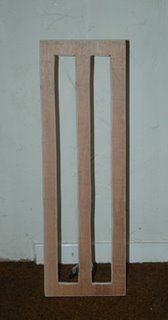 ea was to cut these into stump shapes and see if that’s any stronger? The idea being that once cut these would somehow be slotted into a chunky base, much the same as the old style that have been broken. The idea being as it’s plywood it should be stronger than straight forward wood? So with drills and an electric saw Joe (My 5 year old) and me set to it.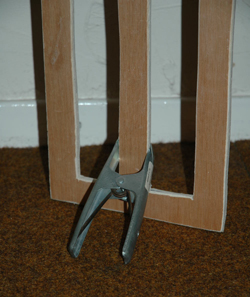
This is what we came up with, it approximates the size of real stumps and is basically just a target at which to aim the ball or defend depending on what you’re doing. We’ll paint them white before the practice.
Giving it some thought later on as to how to make the things stand up, but then not be ridged to the point where if they’re hit by a fast ball they’re not going to give at I realised they need to be so that as soon as they’re hit they fall over or at least give.
This is the solution I came up with – market clamps see below. They’re light and strong and should come away from the stumps if hit (Even if soft) so in theory not be so susceptible to be being broken?
They’re strong enough to hold the stumps upright and offer an easy solution to the problem. So we’ll give these a go?
Training
So now my backs a little better, I’ll start training again, but this time not over-do it
It’s been suggested in some quarters that we need to structure the practice sessions in some way. I’m still of the opinion that we should still keep it loose for a couple of weeks, but maybe with more emphasis on the bowlers getting the opportunity to bowl more? I’ve tried to figure out a way of rotating the bowling and batting, but there always ends up a couple of people wicket keeping who are not necessarily the wicket keepers. So unless someone else comes up with something I reckon we should keep it fun and loose. If you’re one of the bowlers take it upon yourself to do as much as you wish. That then leaves openings for Tom, Mark, Naughty and Steve Bone to concentrate on batting and becoming the key Batsman unless of course they’re still up for other duties? But I’m of the opinion people now need to take their places within the team and start to specialise
The situation seems to me to be this – All of us have to bat. There’s four people that have the potential to specialise in batting as they’ve not yet indicated they feel they have the potential (or willing to train) to be Bowlers or Wicket Keepers. As far as I’m concerned I’d like for these people to become specialists in batting –
Tom, Naughty, Mark and Steve – Specialist Batsmen
Richard (AR) and Alex (AR) – Specialist Wicket Keepers
Dave – Specialist Leg Spin Bowler
Thomas (AR) and Rod (AR) Specialist Fast swing bowlers
Simon (AR), Alex and Badger (AR) Specialist Fast Seam bowlers
Those that have (AR) after their names, seem to me to be good all rounders in that they can bat pretty well too!
Match Rules
It looks as though this coming weekend we may have our best turnout yet with the potential for 13 blokes turning up. If it turns out that we do have 10 or 12 we could aim to play some of the ECB rules for indoor cricket.
Here’s some of the rules in brief. We’ll leave the byes and leg byes. Wides we’ll give a point to the batting team.
There’s some white boards, so I’ll try and remember to take a pen and we’ll keep scores. The fifth or sixth man from the batting team can act as umpire
· 12 x 6 ball overs – maximum of 3 overs per bloke
· 6 Two batsmen shall be at the wicket at all times during aninnings. In the event of a team losing five wickets withinthe permitted 12 overs, the last man shall continuebatting with the fifth man out remaining at the wicket asa non-striker.
· When a batsman reaches or passes a personal total of25 he shall retire, but may return to the crease on thedeparture of the fifth batsman. Retired batsmen mustreturn in order of their retirement and take the place ofthe retiring or dismissed batsman. Two 'live' batsmenshall be at the wicket until such time as the fifth wickethas fallen. The batsman shall retire again when he scoresan additional 25 runs on his return to the crease unlesshe is the last remaining batsman, in which case he cancomplete his innings.
· A ball struck to hit the boundary wall behind the bowlerwithout touching the floor or any other wall or ceilingshall count boundary 6 runs. If, however, the ball touchesthe floor but does not touch any of the other walls or theceiling and hits the boundary wall, then it shall count asboundary 4 runs.
· Before the toss, the umpires shall agree with bothcaptains the exact interpretation of 'boundary wall','ceiling', 'side wall' and 'back wall'.
· A ball struck to hit the ceiling or one or more of the sideor back walls shall count 1 run, even if the ballsubsequently hits the boundary wall in which case itremains in play.
· 2 additional runs shall be scored if the batsmen complete a run (if the ball is struck to hit the ceiling or side or back wall and a batsman is then run out1 run shall be scored).
· 2 runs shall be scored if the striker plays the ball and itdoes not hit a wall and the batsmen complete a run.
· Methods of dismissalApart from the normal methods of dismissal contained inthe Laws of Cricket, the following variations shall apply:
· The batsman shall be caught out by a fieldsman after theball has hit the ceiling, the netting or any wall exceptdirectly from the boundary wall, provided the ball has nottouched the floor.
· The last not-out batsman shall be given out if the nonstrikerrunning with him is given out.
· The batsman or the non-striker shall be given not out ifthe ball rebounds from a wall or ceiling and hits a wicketwithout being touched by a fieldsman.
Net News
Other news – I went over to the hall tonight to see if the caretaker had managed to get that pole out of the nets that seemed to be preventing us from pulling the nets out fully. He’d forgotten, so I offered to give him a hand with it and we got it sorted tonight using a ladder, so hopefully on Saturday they come out all the way.
Stump news
It looks as though we may have 4 sets of ‘Stumps’ I’ve designed a new type which will fall over rather than disintegrate……
At the last mpafirsteleven some of the fast bowlers smashed the stumps, so I’ve been thinking what can we do on the cheap to replace them that’ll work and possibly not break so readily. Yesterday I got some plywood 12mm for nothing and the id
 ea was to cut these into stump shapes and see if that’s any stronger? The idea being that once cut these would somehow be slotted into a chunky base, much the same as the old style that have been broken. The idea being as it’s plywood it should be stronger than straight forward wood? So with drills and an electric saw Joe (My 5 year old) and me set to it.
This is what we came up with, it approximates the size of real stumps and is basically just a target at which to aim the ball or defend depending on what you’re doing. We’ll paint them white before the practice.
Giving it some thought later on as to how to make the things stand up, but then not be ridged to the point where if they’re hit by a fast ball they’re not going to give at I realised they need to be so that as soon as they’re hit they fall over or at least give.
This is the solution I came up with – market clamps see below. They’re light and strong and should come away from the stumps if hit (Even if soft) so in theory not be so susceptible to be being broken?
They’re strong enough to hold the stumps upright and offer an easy solution to the problem. So we’ll give these a go?
Training
So now my backs a little better, I’ll start training again, but this time not over-do it
Saturday, January 27, 2007
Michael Vaugn On the BBC
Have a look at this Michael Vaughn talking about captaincy
http://news.bbc.co.uk/player/sol/newsid_5410000/newsid_5410900/5410938.stm?bw=bb&mp=rm
Copy the above and paste into your browser. I like what he says about the bowlers being able to set their field when they're bowling. Having never played a competitive game I've got no idea about how much time is given over to discussing field placings when you're given the nod to bowl, is there such a thing as wasting time in cricket if you're deemed as taking too long to make decisions about bowling?
http://news.bbc.co.uk/player/sol/newsid_5410000/newsid_5410900/5410938.stm?bw=bb&mp=rm
Copy the above and paste into your browser. I like what he says about the bowlers being able to set their field when they're bowling. Having never played a competitive game I've got no idea about how much time is given over to discussing field placings when you're given the nod to bowl, is there such a thing as wasting time in cricket if you're deemed as taking too long to make decisions about bowling?
Friday, January 26, 2007
Strategies & team selection
Next Net Practice
It’s looking like we’re moving towards having an idea who is going to form the main core of the team and I’m glad to say it’s MPA blokes with a few ringers. As Alex has said the ringers are shaping up nice in that we’ve got Thomas who’s good with the bat and possibly got potential with the bowling too, the Aussie bloke Rod’s looking handy at bowling as well so things are coming together.
My own feeling is that at the moment while we’re still finding our feet and getting a sense of who’s up for this and who’s just in for a laugh the loose arrangement with the net practice is fine. But I reckon we’ve got to look at it being more structured fairly soon otherwise we’ll have no sense of going forward with a strategy. As far as I’m concerned we’re winning the psychological battle and all we need now is to gain more confidence with the skills and techniques and that’s going to come about through people deciding on their specialities and aiming to hone their skills. For me I need to know who is going to be the wicket keeper and for that person to take up the role more seriously in order that we can practice together and work as a unit as the relationship is essential to the success of the team (Gilchrist and Warne).
Simon says that we need around six bowlers, so over the next couple of weeks maybe we should pinpoint who these bowlers are? Similarly we need to ascertain who will be our key batsmen and allow them to get the necessary time in the nets facing the key bowlers? So it’s a case of – if you want these roles you’ve got to step up and be counted and prove yourself possibly? I dunno – this is where we need the captain to step in (Alex)?
To reinforce the practice angle – check this out from www.harrowdrive.com
How to run an effective net
Posted on Sunday 23 July 2006
Club cricket nets are often wasted opportunities, despite being more popular with players than ever. To make a net more effective for everyone involved, follow my guide to making your cricket nets better training:
How to run an effective cricket net
The key element is to nominate someone to take overall charge of the net. Ideally this will be the club captain or coach, but anyone can do it as long as there is a person in charge.
Set the tone and build team spirit by warming up effectively before you go near the net.
Set session goals for each individual (for example, practice driving along the ground or work on slower ball).
Try and simulate match conditions as closely as possible. Here are some ideas:
Separate nets for seam and spin bowlers.Have a wicketkeeper in the spinners net.Only players likely to bowl in a game to bowl.Bowlers to set imaginary field before bowling.Use ground markers to help with line/length.Opening bowlers bowl to opening batsmen with a new ball.Bat in pairs and have calling and running between the wickets.Bowlers bowl an over each instead of one ball at a time.Challenge bowler to see how many balls they can deliver before batsman can leave it.Set batsman realistic run scoring targets.And if you want to be really hard: If you are out, you are out of the net.
Finish with an effective cool down, stretch and comments from captain or coach.
Also consider playing a practice game instead of having a net. It is more realistic, more challenging and can be a modified to ensure everyone gets the practice they want (for example batting in pairs for a set time).
More on various practice games soon.Filed in:Coaching cricket drills ideas nets netting practice tactics
Dave
It’s looking like we’re moving towards having an idea who is going to form the main core of the team and I’m glad to say it’s MPA blokes with a few ringers. As Alex has said the ringers are shaping up nice in that we’ve got Thomas who’s good with the bat and possibly got potential with the bowling too, the Aussie bloke Rod’s looking handy at bowling as well so things are coming together.
My own feeling is that at the moment while we’re still finding our feet and getting a sense of who’s up for this and who’s just in for a laugh the loose arrangement with the net practice is fine. But I reckon we’ve got to look at it being more structured fairly soon otherwise we’ll have no sense of going forward with a strategy. As far as I’m concerned we’re winning the psychological battle and all we need now is to gain more confidence with the skills and techniques and that’s going to come about through people deciding on their specialities and aiming to hone their skills. For me I need to know who is going to be the wicket keeper and for that person to take up the role more seriously in order that we can practice together and work as a unit as the relationship is essential to the success of the team (Gilchrist and Warne).
Simon says that we need around six bowlers, so over the next couple of weeks maybe we should pinpoint who these bowlers are? Similarly we need to ascertain who will be our key batsmen and allow them to get the necessary time in the nets facing the key bowlers? So it’s a case of – if you want these roles you’ve got to step up and be counted and prove yourself possibly? I dunno – this is where we need the captain to step in (Alex)?
To reinforce the practice angle – check this out from www.harrowdrive.com
How to run an effective net
Posted on Sunday 23 July 2006
Club cricket nets are often wasted opportunities, despite being more popular with players than ever. To make a net more effective for everyone involved, follow my guide to making your cricket nets better training:
How to run an effective cricket net
The key element is to nominate someone to take overall charge of the net. Ideally this will be the club captain or coach, but anyone can do it as long as there is a person in charge.
Set the tone and build team spirit by warming up effectively before you go near the net.
Set session goals for each individual (for example, practice driving along the ground or work on slower ball).
Try and simulate match conditions as closely as possible. Here are some ideas:
Separate nets for seam and spin bowlers.Have a wicketkeeper in the spinners net.Only players likely to bowl in a game to bowl.Bowlers to set imaginary field before bowling.Use ground markers to help with line/length.Opening bowlers bowl to opening batsmen with a new ball.Bat in pairs and have calling and running between the wickets.Bowlers bowl an over each instead of one ball at a time.Challenge bowler to see how many balls they can deliver before batsman can leave it.Set batsman realistic run scoring targets.And if you want to be really hard: If you are out, you are out of the net.
Finish with an effective cool down, stretch and comments from captain or coach.
Also consider playing a practice game instead of having a net. It is more realistic, more challenging and can be a modified to ensure everyone gets the practice they want (for example batting in pairs for a set time).
More on various practice games soon.Filed in:Coaching cricket drills ideas nets netting practice tactics
Dave
Thursday, January 25, 2007
Finance & Kookaburra balls
Alex asked about the Kookaburra Balls and the possibility that we may buy some more? Last week with the attendance we made an excess of £30, but I've yet to still recoup my £140 outlay on the monthly hire fee. So this coming session anything over 4 people attending will see me paid off and the remainder of the money available to buy gear with - Balls, helmets, bats or spring back stumps for instance? The projected attendance what with the current enthusiasm levels should be at the very least 10 people again meaning we'll have an excess of £70 in the coffers. Having said that I feel it would be better to have £140 in hand in order that I don't have to fork out the deposit again and become overdrawn or use my savings. So in the short term that's seems a reasonable strategy? All of the money collected, spent or held I'll keep an excel spreadsheet of listing who's paid in and who attends etc and at any time if you want to have a look at it I'll produce it. I could even print it off each session for viewing at the after practice analysis.
On the subject of the balls – my feeling is that we have enough pads and gloves to use the real thing. If the bowlers are going to get any practice that’s worthy I think it needs to be conducted with the real thing and there are several people that agree with this, obviously if you don’t fancy the real balls opt for the Kookaburra ones and yes in time we’ll get some more. But as far as I’m concerned using the kookaburra’s is potentially setting me on a backward step and if you’re looking to be one of the batsmen in the first six you too should be getting used to the idea of having big F****s like that Kiwi bloke (6’8” x 3’6” of muscle) trying to throw a hard ball at you at 80mph!
On the subject of the balls – my feeling is that we have enough pads and gloves to use the real thing. If the bowlers are going to get any practice that’s worthy I think it needs to be conducted with the real thing and there are several people that agree with this, obviously if you don’t fancy the real balls opt for the Kookaburra ones and yes in time we’ll get some more. But as far as I’m concerned using the kookaburra’s is potentially setting me on a backward step and if you’re looking to be one of the batsmen in the first six you too should be getting used to the idea of having big F****s like that Kiwi bloke (6’8” x 3’6” of muscle) trying to throw a hard ball at you at 80mph!
Practicing
25th Jan
If anyone feels inclined to contribute to the blog you can do so by either emailing me and I’ll put the stuff straight into the blog or you can log on to www.blogspot.com get yourself a blog and then from there you can link to mine. I’m not suggesting you maintain your own blog in the way that I do here, but by having a blog it will enable you to make contributions.
I got a response from Alex today re my questions about bowling leg side with RH handed batsmen.
Hey Dave –
Seems you are famous on the net, you’ll be the ECB development officer for Essex or something before you know it!. New venue was cool, there was plenty of space and the nets did the job – the two ringers you have lined up are rather handy at batting and bowling it must be said, nice one! Are we getting a few more kookaburra plastic balls (like the red and white one) for next practice or a couple more real ones (personally I’m more than happy to bat against real ones for the whole session)?
On the bowling front you are correct that the aim with the standard leg spin bowl is to hit the bowlers foot holes (batsman’s end obviously) outside leg stump and spin the ball viciously back in, this may elicit some playing and missing (as in your diagram) but standard procedure for batsmen (with pads) is to just stick a leg in the way of the delivery (since anything bowled outside leg stump cannot given out LBW). If you spin it less than the batsman expects you may well end up with an outside edge nick probably going to square leg. The key is mixing it up as you do so when you bowl in line (particularly if the batsman is just padding up to you) the batsman expects the ball to spin outside the off stump and will try for a square cut (off side shot) thinking it’s a loose one they can hit, however this is where you bowl one that stays straight gaining a inside edge or a complete miss (giving the chance of bowled or played on, stumped or LBW). I personally found your bowling pretty difficult to hit due to the variation and the fact I’m not so good with wider deliveries (I like it straight) so it slowed my scoring down which is the primary aim – it gets the batsman frustrated and makes them hit rash shots (as I did at the end of the over). Keep persevering with it. What you do need though is a few more close fielders to put pressure on the batsman and the keeper needs to play right up at the wicket to take nicks and stumpings.
Hope that helps
Al J
On the www.harrowdrive.com website tonight the topic of discussion was practicing and improving. The bloke was saying that it takes something like 10,000 hours to get really good a cricket. Which is 416 days of non-stop cricket. Even if you put in 3 hours a day 365 days a year that’s 9 years before you’re really good. I can’t imagine a fat biffa like Shane Warne practiced at that rate leading up to his dismissal of Mike Gatting? It’s probably the case that the people that are exceptionally good at it are either simply Australians or naturally gifted. There’s just some things in life you can do and others you can’t and you know intuitively that there’s no way you’re ever going to be playing for Arsenal, or on centre court at Wimbledon by the time you’re 21. So for the likes of us it’s a case of practicing as much as we can just so long as we have our day of glory when we see those sports science blokes drowning their sorrows in their diet cokes at the bar of Welstead Gardens some time in the summer (Surely they don’t drink do they – they’re machines, their bodies are temples to sports science and human perfection)?
I spoke to them again today and they’re playing it cool. I think we’ve got them on the ropes, I asked the big bloke how many different variations he had in with his bowling (He’s their leg spin bowler) and he said just the leg break, then laughing he said that their opening fast bowler was the big Kiwi geezer and some other tall bloke that I didn’t know. Then the Kiwi bloke walked past and I mentioned it to him and he didn’t have a clue and certainly isn’t a fast bowler! So I think we’re winning the psychological game. I may even up the ante a bit and start leaving coaching handouts on the printer for them to come across and give the impression that we’re really going for it!
Back to the issue of 10,000 hours. I certainly haven’t got 10,000 hours of cricket life in me, I’ll be dead before then, but I’ll be aiming to get out and bowl as much as I can when I can leading up to the games to get my line consistent.
The great news is that club spinners don’t need to produce magic balls to rip through the opposition like seamers do.They can do it with a decent level of accuracy, a confident captain who sets the right fields and an opposition who cannot resist having a go (and let’s face it, most club batsmen fancy themselves against spin).
On the subject of games I reckon we should push the idea that we should play a series of three games with the sports science blokes, so we can really rub their noses in it with a 3-0 white wash!
If anyone feels inclined to contribute to the blog you can do so by either emailing me and I’ll put the stuff straight into the blog or you can log on to www.blogspot.com get yourself a blog and then from there you can link to mine. I’m not suggesting you maintain your own blog in the way that I do here, but by having a blog it will enable you to make contributions.
I got a response from Alex today re my questions about bowling leg side with RH handed batsmen.
Hey Dave –
Seems you are famous on the net, you’ll be the ECB development officer for Essex or something before you know it!. New venue was cool, there was plenty of space and the nets did the job – the two ringers you have lined up are rather handy at batting and bowling it must be said, nice one! Are we getting a few more kookaburra plastic balls (like the red and white one) for next practice or a couple more real ones (personally I’m more than happy to bat against real ones for the whole session)?
On the bowling front you are correct that the aim with the standard leg spin bowl is to hit the bowlers foot holes (batsman’s end obviously) outside leg stump and spin the ball viciously back in, this may elicit some playing and missing (as in your diagram) but standard procedure for batsmen (with pads) is to just stick a leg in the way of the delivery (since anything bowled outside leg stump cannot given out LBW). If you spin it less than the batsman expects you may well end up with an outside edge nick probably going to square leg. The key is mixing it up as you do so when you bowl in line (particularly if the batsman is just padding up to you) the batsman expects the ball to spin outside the off stump and will try for a square cut (off side shot) thinking it’s a loose one they can hit, however this is where you bowl one that stays straight gaining a inside edge or a complete miss (giving the chance of bowled or played on, stumped or LBW). I personally found your bowling pretty difficult to hit due to the variation and the fact I’m not so good with wider deliveries (I like it straight) so it slowed my scoring down which is the primary aim – it gets the batsman frustrated and makes them hit rash shots (as I did at the end of the over). Keep persevering with it. What you do need though is a few more close fielders to put pressure on the batsman and the keeper needs to play right up at the wicket to take nicks and stumpings.
Hope that helps
Al J
On the www.harrowdrive.com website tonight the topic of discussion was practicing and improving. The bloke was saying that it takes something like 10,000 hours to get really good a cricket. Which is 416 days of non-stop cricket. Even if you put in 3 hours a day 365 days a year that’s 9 years before you’re really good. I can’t imagine a fat biffa like Shane Warne practiced at that rate leading up to his dismissal of Mike Gatting? It’s probably the case that the people that are exceptionally good at it are either simply Australians or naturally gifted. There’s just some things in life you can do and others you can’t and you know intuitively that there’s no way you’re ever going to be playing for Arsenal, or on centre court at Wimbledon by the time you’re 21. So for the likes of us it’s a case of practicing as much as we can just so long as we have our day of glory when we see those sports science blokes drowning their sorrows in their diet cokes at the bar of Welstead Gardens some time in the summer (Surely they don’t drink do they – they’re machines, their bodies are temples to sports science and human perfection)?
I spoke to them again today and they’re playing it cool. I think we’ve got them on the ropes, I asked the big bloke how many different variations he had in with his bowling (He’s their leg spin bowler) and he said just the leg break, then laughing he said that their opening fast bowler was the big Kiwi geezer and some other tall bloke that I didn’t know. Then the Kiwi bloke walked past and I mentioned it to him and he didn’t have a clue and certainly isn’t a fast bowler! So I think we’re winning the psychological game. I may even up the ante a bit and start leaving coaching handouts on the printer for them to come across and give the impression that we’re really going for it!
Back to the issue of 10,000 hours. I certainly haven’t got 10,000 hours of cricket life in me, I’ll be dead before then, but I’ll be aiming to get out and bowl as much as I can when I can leading up to the games to get my line consistent.
The great news is that club spinners don’t need to produce magic balls to rip through the opposition like seamers do.They can do it with a decent level of accuracy, a confident captain who sets the right fields and an opposition who cannot resist having a go (and let’s face it, most club batsmen fancy themselves against spin).
On the subject of games I reckon we should push the idea that we should play a series of three games with the sports science blokes, so we can really rub their noses in it with a 3-0 white wash!
Tuesday, January 23, 2007
We'll have some of that!
Having now read the article previously mentioned I'm going to use in our blog - Have a look there's some good ideas in here. One that Simon had previously mentioned regarding getting our own shirts "Make sure we've all got intimidating nicknames on the back" he said down the pub after the last practice.....
How does Dave continue to turn those screws and get the opponents ready to lose?
Club Clothing. Nothing says ‘we are a team’ more than all looking alike. That means as much club clothing as possible. Caps are great because they are cheap but so are jumpers, shirts, tracksuits and, if you are really keen, training shirts.
Impressive Drills. Fielding drills are not just a way to practice your fielding. Make sure you have one drill that looks complicated and difficult (but is actually easier than it looks) and perform it with the whole team when the opposition are looking on.
Team Talks. Another team unity trick is to ensure the opposition know that you are plotting their downfall. This works on matchday by having a team huddle before play or running out of the dressing room together. In Dave’s case he can work on them off the pitch by consipring in corners with fielding diagrams within the eyeline of the others.
Sledging. Banter is a vital part of cricket. If you can put opponents in a negative frame of mind by pointing out their cricketing shortcomings you make them doubt themselves. This also works if you make it seem like you are training harder than them too. Drill plans, books on cricket, getting fit and practicing all the time are great ways to do this.
All these tricks are relatively negative but effective. They knock the other team down rather than build your team up. You can get them ready to lose, but you also need to be ready to win. That means never giving up, trusting yourself and knowing your tactics.
Good luck Dave, and good luck everyone else joining (or starting) a team in 2007.
I like the idea of leaving books all over the place - especially on my desk where Dean Wells has to walk past!
How does Dave continue to turn those screws and get the opponents ready to lose?
Club Clothing. Nothing says ‘we are a team’ more than all looking alike. That means as much club clothing as possible. Caps are great because they are cheap but so are jumpers, shirts, tracksuits and, if you are really keen, training shirts.
Impressive Drills. Fielding drills are not just a way to practice your fielding. Make sure you have one drill that looks complicated and difficult (but is actually easier than it looks) and perform it with the whole team when the opposition are looking on.
Team Talks. Another team unity trick is to ensure the opposition know that you are plotting their downfall. This works on matchday by having a team huddle before play or running out of the dressing room together. In Dave’s case he can work on them off the pitch by consipring in corners with fielding diagrams within the eyeline of the others.
Sledging. Banter is a vital part of cricket. If you can put opponents in a negative frame of mind by pointing out their cricketing shortcomings you make them doubt themselves. This also works if you make it seem like you are training harder than them too. Drill plans, books on cricket, getting fit and practicing all the time are great ways to do this.
All these tricks are relatively negative but effective. They knock the other team down rather than build your team up. You can get them ready to lose, but you also need to be ready to win. That means never giving up, trusting yourself and knowing your tactics.
Good luck Dave, and good luck everyone else joining (or starting) a team in 2007.
I like the idea of leaving books all over the place - especially on my desk where Dean Wells has to walk past!
It's a small world out there!
Check this out! I got in tonight turned on the internet and looked through my emails. The only email of the day was from a website that I subscribe to called www.harrowdrive.com the website has loads of useful links and articles relating to fitness, tactics, captaincy and all things cricket including psychology. So I was interested to see that tonights instalment was going to be about Cricket psychology and winning. I opened up the link, read the intro and then had to do a double take because they'd lifted a bit off our blog! Have a look...... http://www.harrowdrive.com/category/tactics/ how funny is that!
Dave
Dave
Sunday, January 21, 2007
Post practice analysis
Again disappointed with myself initially after the net practice I spent Sunday afternoon bowling on grass again trying to rectify my mistakes. This time bowling 51 overs back to back and again on grass doing so much better despite it being wet. But thinking about it, the practice in the nets although it was awful for the first 90 minutes because I couldn't get my length or placing right it did come together during the session where we were playing against each other. Yeah I bowled loads of wides, but the length and the variations worked. Okay I didn't bowl anyone out but almost everyone without exception was knocking short balls right up into the air and in a match would no doubt have been caught out. I also edged a few and a couple of people were caught behind, so in affect I did okay? You tell me - is that tr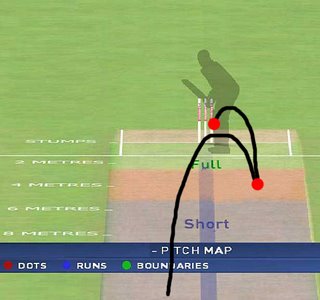 ue?
ue?
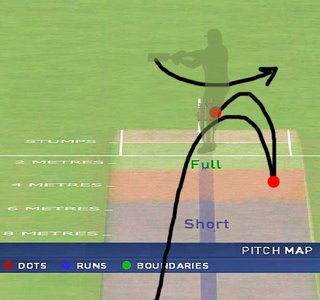
I've also got a question for you experts out there. If I'm bowling against a RH batsman I am allowed to bowl down his leg side aren’t I with the intention of making the ball swing in round the back of his legs? (See the first diagram left). Does it then follow that if I was to bowl a straight ball fairly wide I'd get away with it as if the batsman was to try a hook, sweep or square cut shot the length of their arms and bat would extend quite some distance? (See image below).
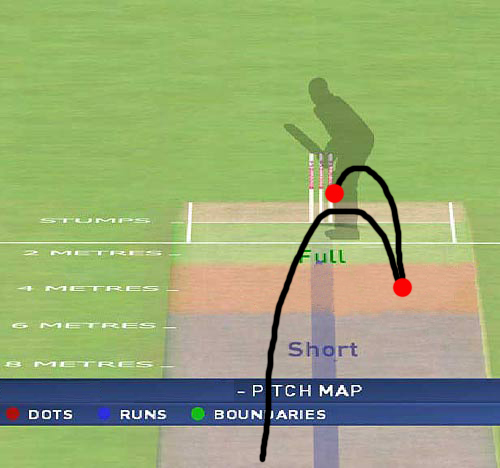 ue?
ue?I've also got a question for you experts out there. If I'm bowling against a RH batsman I am allowed to bowl down his leg side aren’t I with the intention of making the ball swing in round the back of his legs? (See the first diagram left). Does it then follow that if I was to bowl a straight ball fairly wide I'd get away with it as if the batsman was to try a hook, sweep or square cut shot the length of their arms and bat would extend quite some distance? (See image below).
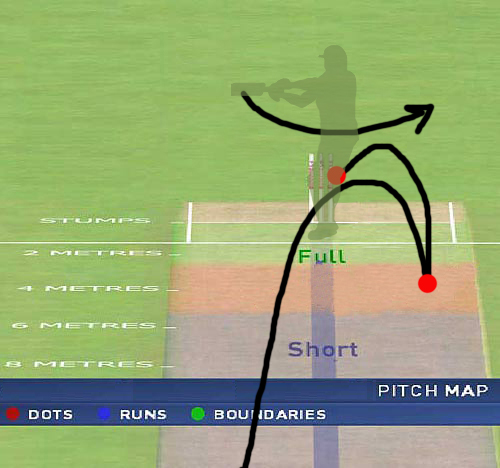
Friday, January 19, 2007
They've taken the bait
Sports science have taken the bait! I emailed Dean Wells today and reminded him of the challenge. He then obviously distributed the email to his blokes and then there ensued a bit of mild sledging across the team rooms. From what I could gather a few of them play a bit of cricket. Dean himself plays, so does the big bloke to his right - he played at county level as a kid and 'Yeah I throw a bit of spin' was his comment to me asking if anyone was a spin bowler. The funny bloke plays as well and they all said they were medium pace bowlers. Later in the day I spoke to the scouser and the big bloke on the way out and they were joking, but the sense I got was that they felt ill prepared and as though we'd got the jump on them....... "We'll have to get the dept to see if there's money in the budget to pay for a bowling machine down at Garrons". So they don't seem as though their bowlers are up to the grade to put their batsmen through thier paces! I reckon we've got the psycological edge on them already, they'll all be thinking now - 'that's why that twat walks around with a cricket ball all the time' then realise I've been doing so for months and that we might be serious about this!? The plan is coming together - I can smell victory already, we've already won the psycological battle, all we need to do is turn the screws a bit more......
Subscribe to:
Posts (Atom)