Showing posts with label scrambled seam. Show all posts

Wednesday, December 24, 2014

Wrist Spin Bowling - Top-Spinner

The Top-Spinner.(updated 1st April 2015)

The Top-Spinner or 'Over-Spinner' is one of the variations bowled by Wrist Spinners. The ball is flicked out of the hand using a combination of wrist and fingers to impart the spin, the seam of the ball is released so that it's upright, as per the diagram below seen from above.


The grip is the exactly the *same as the Leg Break ...2 fingers up, 2 fingers down as described by both Jenner and Warne the view that the batsman would see would be as in the image below (fig 1). This I would describe as an orthodox wrist spinners grip with the ball cupped in the hand and the 3rd finger (ring finger) rested on the seam.
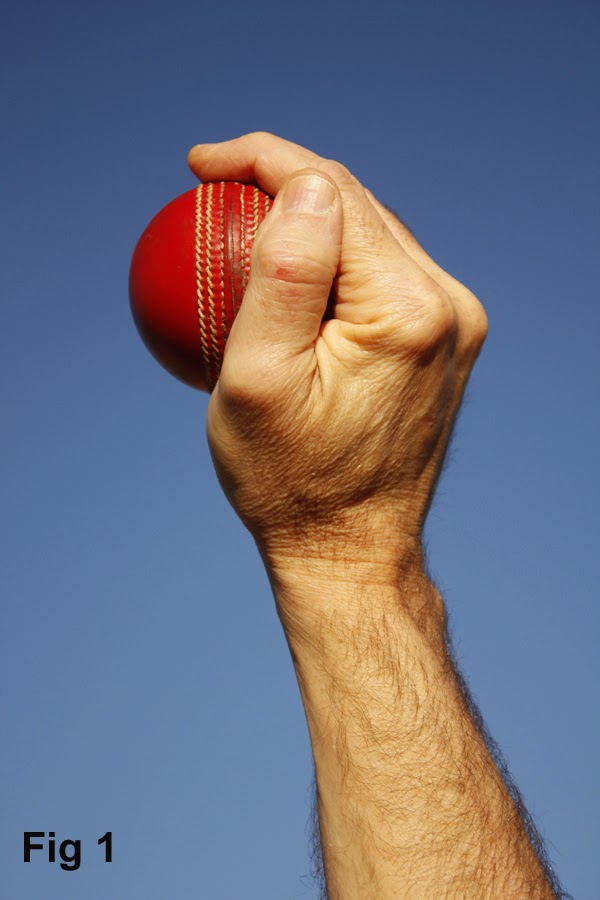
The thumb plays little or no part in the release generally, the 3rd finger is rested on the seam highlighted here below in fig 4. This finger on the seam is the means by which the spin is imparted, combined with the flick of the wrist.
 
 
 Characteristics

Delivered as nears as possible in the same way as your stock ball, the wrist position is changed so that the side spin on the ball is negated, the seam rotates over itself aimed directly down the wicket. The harder the ball is spun, the more the ball will be effected by the Magnus Force making the ball dip as it reaches the batsman. The impression from the batsman's perspective would be that the ball is going to be a lot fuller, landing a lot close to his position in the crease. With the top-spin, the ball would then dip late in its trajectory dropping short, the result is that often the batsman would play the shot timing it incorrectly resulting in the ball spooning up in the air.

The flight of the ball would appear based on its release height and speed to be a much fuller ball (Indicated by the white line), but with the top-spin the ball would suddenly drop short as indicated by the red line. One of the better descriptions of the Top-Spinner can be found on Pencil Crickets blog, he writes...

Wrist-spin Applications #1: The Top-spinnerI've started with the top-spinner rather than the stock legbreak as this is by far the easier delivery to describe, so it's a good starting point. I'm assuming it's a "pure" top-spinner, i.e. that the seam is vertically upright and pointing down the wicket.

Essentially, all you have to do to work out what the Magnus effect will do with this ball is take the golf ball and turn it upside down, so that instead of pushing the ball up it pulls it down instead.

Now here, for once, I have to take issue with Peter Philpott. In his otherwise flawless book "The Art of Wrist-Spin Bowling" he describes the effect of top-spin (he calls it overspin) saying that "overspin increases the effect of gravity", a bit of sloppy science that will have all the physics teachers rolling their eyes. The effect of gravity is unchanged throughout - what top-spin does is add an additional effect which accelerates the ball in the same direction. So the ball has the downward acceleration due to gravity AND some more downward acceleration due to the Magnus effect on top of that.

So as the batsman sees the ball come out of the bowler's hand, he will judge the speed and angle and intuitively estimate where the ball will pitch based on downward acceleration due to gravity alone. Thereafter the Magnus effect will make the ball dip faster in the air, and bounce further away from the batsman than he originally thought it would. That's not all, however. Because the ball has dipped it will now hit the ground at a steeper angle, and therefore it will bounce higher.

Now anyone who has ever spun a ball onto the floor in front of them will find this last part counter-intuitive. If you gently chuck a top-spinning ball onto the floor in front of you the traction as it lands will accelerate it away from you, making the angle it bounces up at shallower. Likewise a back-spun ball will seem to sit up, and if you give it a really good rip you can even get it to bounce right back towards you despite its original momentum. However - and spinners need to get their heads round this - at any significant speed the Magnus effect's ability to make the ball hit the ground at a steeper angle and thus bounce harder and higher far outweighs this effect. It's not that the effect doesn't exist, after all it's the same force that makes a leg-break turn, it's just that it is dwarfed by a counter-acting force in this situation.

So the Magnus effect will make a top-spun ball dip more during flight, meaning it will pitch shorter than anticipated, and hit the ground at a steeper angle, making it bounce higher.


http://pencilcricket.blogspot.co.uk/p/magnus-effect-in-leg-spin-bowling.html

Relatively easy to bowl if you have a high arm action as opposed to a low action. A lower 'Round Arm' action requires a potentially more difficult wrist position if you're looking to bowl the delivery making it indistinguishable from your stock Leg Break.

How to use it? I've seen it used in a variety of ways, especially effectively by older bowlers who've got very good control over their line, length and speed. If you've got that kind of accuracy and you're bowling against tail-enders or someone who's desperate to stay in for whatever reason, this ball can tie an end down, dry up runs and put pressure on the other batsman.

But generally you can vary it with the afore-mentioned aspects - line, length, flight/speed, more or less spin. Mixed in with your Leg-Breaks - to suddenly bowl one, when the batsman is looking to play the break off the wicket, the fact that it's straight will potentially cause problems and with the extra bounce the ball may come off the gloves, bat handle or the shoulder of the bat to be caught behind.

New Batsman in.  On SKY during a break in a test match in 2012/13 Warne did a piece where he discussed his initial approach to bowling to a new batsman using the crease. (See the link above). This is kind of reliant on your ability to bowl a decent line and length, but he advised to bowl from different positions on the crease, either side of the stumps for the most part attacking the stumps. There are further thing you have to consider, field placement for one. Because it's a new batsman you have to consider when you've been brought on and how you faired in the previous over if you've already been bowling. But if you've done okay in the previous overs, this'll be your licence to go on the attack. Bring the field up and right from the outset give the impression something is going to happen.

Warne's exact order or approach I've not revisited or replicated here, but I've adapted it for my own use, but it was pretty simple, something along the lines of...

1. Over the wicket, Stock Ball, off-stump line coming off of a normal position on the popping crease, close to the stumps. The ball is delivered attacking an off-stump line (C), with the expectation that the ball will break off the wicket (B). In the first over your tactic could be to hold back the Top-Spinner which would take the red dotted line route (D) hitting middle and off.

2. Over the wicket, Stock Ball, off-stump line, but go wider on the wicket further from the stumps. Again your targeting the stumps forcing the batsman to play a shot, all the time creating chances with your leg break turning it away from the edge of the bat.

3. Over the wicket, Stock Ball, but wide of the stumps on the off-side, going back to the close to the stumps delivery approach. This is useful to see how much the batsman moves his feet, giving some indication as to how confident they are. Again all of these balls are reliant on the consistency of your stock ball, if your moving around on the crease, but bowling a regular pace and flight, there'll be a growing confidence in some aspect of the batsman own perception of what is happening. He maybe thinking at this stage "Right... this bloke is moving his position on the crease, but the flight and pace are pretty much consistent"... Which is pretty much what you want him to be doing?
If he's not that good, he may not move his feet at all and may swing at the ball, or lean out to hit it, again all potentially clues to how well he's going to play the ball once you get going.

4. Over the stumps, Stock Ball, wide on the crease, but a leg stump line. This is where you'll start to see if the batsman is strong off his legs. I find this a riskier line along with the final two approaches which see me go around the wicket attacking the leg-stump.


5. Around the stumps, Stock Ball, close to the stumps, leg-stump line. Now really mess with his head and your team mates if you don't rearrange your field! Go around the stumps attacking the leg-stump, again don't forget you're still bowling your stock ball leg break, so you're turning it into the batsman, but forcing them to play the ball because you're attacking the stumps. I find this the riskier of all the tactics so far, as often the batsman will come after you if they've got any real confidence with the bat, but alternatively, you might find that bowling around is a loophole that you can definitely look to exploit? But set your field accordingly - again how you do this either supports your own sense of confidence or indicates some concern, so again I go with giving the impression that something is going to happen for me, rather than giving the impression that the batsman is going to smack you over the boundary. Maybe bring blokes over from the off-side and have close in fielders, I have a bloke in my team who loves fielding at silly midwicket, so he'd be brought in to that position and be right under the batsman's nose.

6. Around the stumps, Stock Ball, wide of the stumps, wide of leg stump. Again change your line go wide on the crease away from the stumps, if you have just been hit over the boundary, take this line but do something additional - you've already bowled 5 stock deliveries - maybe change the pace as well as the angle? Or stick with what you've been doing ready to deliver the sucker punch in the next over?

Having now bowled a whole over of Stock Ball leg breaks and seen the response, go back to the approach that looked the most promising, chuck a couple up and see what happens and then bring in the Top-Spinner. Hopefully the delivery will be so different with extra dip and bounce, added to the fact that you've discovered the best line of attack, the Top-Spinner might be the ball that gets you the wicket?

The amount of variations that can be bowled, simply by moving around on the crease and bowling different lines, lengths, pace gives the batsman something to think about. I think Warne also suggests supporting this probing approach with also tweaking the field settings, moving a bloke a few paces here and there, again to give the impression that you know what you're up to and you're putting a plan together. Again with the field settings added to the fact that you're attacking from different positions on the crease, this all adds up to adding potential pressure to the batsman.

This idea of moving around so much on the crease is that (1). It has the potential to not allow the batsman to feel as though he's in control. (2). You're exploring real options, one of these approaches might give some indication early on that there's a weakness that you can exploit in the batsman's technique. Once you've had a look and there does seem to be a particular approach that looks as to be an attacking option that might bring a wicket, in your next over explore that option and vary your stock ball and then bung in the Top-Spinner as a variation?

The ball is generally used sparingly amongst the stock leg-break with the intention that the characteristics of the delivery catch the batsman out.

Other Factors None of this is easy, but one thing you do need to have in place before you're able to put these plans into place is a good degree of control over your leg break. First and foremost almost everyone will tell you, you have to master the leg break before moving on with any conviction with the variations. If you can try and get your coach or club to lend you a copy of the ECB's video 'Wings to Fly' and have a listen to Warne's coach Terry Jenner. Similarly check out all of the videos on-line that feature Jenner talking about wrist/leg spin bowling.

Pitch Conditions - These have to be considered in relation to how and what you bowl, but this comes with experience. If the wicket is bouncy or has irregular bounce your away and this should produce successful outcomes. If the wicket is a batting wicket and there's no variation in it and the bounce is true and consistent, you might have to look to another plan.

Stage of the game - I tend to come on after about 20 - 25 overs, if the openers are still there, they're generally well set and seeing the ball well. In which case a different approach might be needed? The ideal situation is to bowl to the new batsman and you need to work with your team to get the new bloke on strike, set the field and bowl your stock delivery to allow the 'Set' batsman to run a single, getting the new bloke on strike. But, there is the caveat that if your 'Set' batsman looks to be struggling, then implement your bowling plan against him as well as the new bloke.

Sub Variations - Having posted this blog entry and discussing variations on-line here, one of the forum contributors posted this Youtube video of Warne's releases/deliveries recorded in slow motion. Included amongst the deliveries is one that is particularly interesting in that it features a Top-Spinner that is released with a slightly scrambled seam. Watch the video, it's in two sections, the latter footage is slower than the initial footage. At 1.39 seconds the Top-Spinner is released and you can see that the seam doesn't rotate perfectly and there's an element of the seam being scrambled. In the latter stage of the drop at about 1.49 seconds the ball 'Drifts' dramatically towards the leg-side and then hits the ground and goes on as a Top-Spinner should.

As a diagram it would look something like this.
For me as someone that doesn't get the ball to drift that much, I've been led to believe that in order that the ball drifts there has to be a combination of over-spin (Top-spin) and side spin. I've always assumed that the side spin needs to be 'Clean' as opposed to scrambled, so this video footage is a bit of a revelation, meaning that this coming season I'll be looking at trying out Top-Spinners with a scrambled seam looking for the Holy Grail that is 'Drift'.


*Grip Variations - One of the things that Philpott warns against in his book The Art of Wrist Spin Bowling Is the notion that the grip has to be one way or another. I've introduced the idea that the images above represent an orthodox approach to gripping the ball to produce the Top-Spinner, it maybe the case that for most of us this works fine? I've found that, no matter how hard I try and get my wrist so that it produces a perfect top - spinner, the 'Orthodox' approach as described above still breaks a little towards the off-side.
 
Recently looking to get the ball to bounce straight with no break and increased dip, I experimented with a slightly different grip. I've developed a release that looks pretty much the same as the grip in the image (Figure 1) when bowled.


But when looked at more closely (Image A) you'll see that the ball doesn't sit so deep and cupped in the hand as in the case of the orthodox grip. This approach feels a lot more "fingery" and uses the middle finger as opposed to the 3rd (ring) finger to impart the spin (see below)...
The flick of the wrist is imparted in a slightly different way to the leg break because the wrist has to maintain the 'straightness' aspect to get the ball to over-spin. Instead of the wrist being cocked down and inwards, I cock my wrist backwards and the wrist flick as in the diagram here below is as indicated by the arrow, and this combined with the finger action helps to put the spin on the ball. It does require a certain level of dexterity and suppleness of the wrist.
The finger action is also very different to the orthodox method and uses all of the fingers to put the spin on the ball.
You can see the thumb has a big role to play in this method, the thumb and fingers combined with the flick of the wrist twists the ball; the thumb rolls under the ball and all four fingers roll around the ball over the top imparting the top spin. It'll probably feel ridiculously hard to do this initially but with practice it'll come. This is a classic case of requiring the approach that Philpott advocates - spin anything, any where at any time... Sitting watching the television? Pick up an apple and rip the apple from hand to hand using this method and bit by bit you'll feel it coming together and you'll soon see that you're able to impart a fair bit of spin on the ball using this technique.
 
I'm writing this pre-season and I've used this method in its early stages of development against a number of different batsmen in the nets with very promising results. I'm hoping that going forwards with more practice this is going to be a very useful ball, I've also noticed that with a little angling of the wrist, I can also get it to come in to the right handed batsman for a little Googly, which is potentially very useful too.
 

Bibliography

The Art of Wrist Spin Bowling - Peter Philpott, The Crowood Press, 2006
https://www.youtube.com/watch?v=DM9UpUV3fHM
https://www.youtube.com/watch?v=kfZgFi9Q9gc
https://www.youtube.com/watch?v=sFwhAsoax7w
https://www.youtube.com/watch?v=AFfcCsQyqpw
Check out my other blog here - this is all about Leg-spin bowling and nothing else. Double click on the image below.
http://www.legspinbowling.blogspot.co.uk/


Monday, November 28, 2011

Leg Spin Bowling - Drift

Drift - Leg Spin Bowling (Work in Progress)

Also see this new post here with details and links relating to Top-spin and Drift and the use of scrambled seam - http://www.mpafirsteleven.blogspot.co.uk/2014/12/wrist-spin-bowling-top-spinner.html

Update 26th April 2012 - That's not bad this comes up 5th in the Google search for Spin Bowling Drift. Please note that this is work in progress and doesn't at this point include a conclusion. At the moment it is primarily as series of links to videos and articles all looking at and trying to explain Drift. The reason it's here is that I'm trying to come up with an explanation that I'm comfortable with that the layman and the aspiring spinner can grasp without having a degree in Physics.

Strewth! I've been looking through all those physics papers, looking at Laminar flow and the magnus effect, I looked at Pencil Crickets blog where he's put in a massive effort to shed some light on the matter and just now I've looked at Woolmers book "The Art and Science of Cricket". Now... Bob Woolmer was a man with a lot of connections in cricket and there's a pretty extensive list of people that helped him on that book along with a massive bibliography that cites all sorts of sources. But despite this when it comes to both seam bowling and swing and more so in the case of 'Drift' he concludes with the fact that there isn't enough scientific data to actually pin down either of these phenomena and explain fully why they happen.

Dip and the ball staying in the air with back-spin - that's kids stuff, I can't see why anyone would dispute that and it's easy to put into practice and see it happen, but drift, with the ball drifting in the opposite way to the way that it spins... that's just screwed. What doesn't help either - and I don't know if anyone else sees it in the same way as me, but the illustrations in Woolmers book in the spin section seem to completely miss the relevance of the seam with regards to the direction the ball is spinning? So on that note I declare that I've given up on trying to get my head round this whole issue and join the 'Spin hard' brigade and hope that it drifts!;)

Maybe I'll engage with discussions on empirical observations over at www.bigcricket.com One parting glimmer of hope that I'll maintian some interest in this is that - Woolmer in his analysis of Warnes BoC proposes that the ball was spin at almost 90 degrees to the direction of flight and that the axis of the spin was either tilted upwards or downwards which if was the case, kind of ties in with some of the data I found on the effects of laminar flow, but still goes nowhere near explaining drifts direction being opposite to the spin direction.

Read on if you're interested in what I discovered before giving up on this quest...

One of the points of confusion when describing aspects of spin bowling is the direction that the ball seam is pointed in and the method by which we can visualise this aspect. In order to simplify this on the forum I write and comment on I've suggested recently that we talk about the direction in terms of minutes on a clock. This relates to looking down on to the pitch from above. The pitch therefore would run from 0' to 30' Top to bottom.

This is the phenomenon best exemplified here with the famous ‘Ball of the Century’ bowled by Shane Warne. As Warne bowls the ball its initial trajectory sees the ball head off towards Gatting on a conventional straight line, but then towards the end of its flight it veers (Drifts) towards the Leg-side to then ‘Break’ back on to the stumps. It’s this late veering towards the right as the bowler sees it that is Drift. The batsman on the other hand sees the ball veer off to his left as it dips prior to bouncing.

The more you watch videos and read about spin bowling the more frequently you’ll hear about drift and the sense you’ll get from commentators and protagonists’ is that it’s an attribute that you should have as a part of your bowling. But, there’s a universal problem, all of these people mention it and comment on it, but no-one really seems to pin it down, no-one really says - 'this is what you do in order to make the ball drift' apart from the basic 'Spin it hard'. If you start looking a little deeper and changing your search criteria you get the other side of the coin and that's the Heavy on the Physics approach. Dig a little deeper still, and you then end up with Baseball. The reason for this seems to be that they (The Yanks) seem to take far more interest in the technicalities of their sports, maybe its that whole 'Jocks v Geeks' thing that we seem to get fed as a generalisation about the USA? It could be that, if you're not that clever academically you then seek a route through education studying sports science and playing sport at college? As a consequence, it seems as though there's a lot more information over there on the subject of spinning sphere's - specifically baseballs. But what they seem to do slightly better than us is find a middle ground between the 'Spin it hard' explanations and the 'Magnus effect/Physics' explanations. So hopefully I'm going to be able to come up with a good explanation.

The reason I'm trying to get this across in a different manner is in part due to the fact that I'm whats called a Kinaesthetic Learner and understanding complex stuff like this requires a connection with the actual practice, I can't just read it and fully comprehend it and the process has to include tactile experiences. In addition I find my level of comprehension to be enhanced by connecting the reading with the physical and then explaining it in my terms and this is what this blog entry is - a part of the process of comprehending.

To those of us with an enquiring mind including me, this vagueness "Spin it Hard" isn’t good enough, I want to know how and why, what, when and who? How do you make the ball drift and can I ‘turn the drift on’ and can I ‘turn the drift off again’ at will? Surely, if you can have that degree of control you’re moving towards becoming a master of your craft?

So, with these unanswered questions and the whole vagueness issue, I set about looking at what is out there by way of explanation and trying make sense of it and ascertain if it is possible or even desirable to produce drift on demand and what is it you need to do to produce it.

The 'Spin it Hard' section.

Here's a few starting with Terry Jenner - http://terryjenner.blogspot.com/2009/01/drift.html the interesting details in this account are the fact that he focuses primarily on aspects associated with body actions and position - shoulder rotation and side on alignment. He mentions that Top-Spin wont produce drift, as that creates dip and he says that seam alignment needs to be side ways. In this video here (Cloverdale series) he simplifies it, stripping it down to 'If you spin the ball hard it can drift in to the RH batsmans leg stump and spin away sharply towards leg stump'. (1:44 seconds into the vid).

This site here compiled by Julian Fountain is another useful one. It's interesting in that at the start of this website he too questions the lack of understanding associated with Drift and the Magnus Affect, which is the scientific explanation. I find his simple scientific explanation still difficult to grasp in relation to drift. I can see how it works with Top-Spin with the seam aligned between 30 and 60 minutes, but once I try and get my head around the seam aligned at somewhere between 45' and 55' I can comprehend this would still produce the dip that we need, but why it veers off course away towards the Leg-side (drift) I'm still unclear and his explanation doesn't clarify it for me. There's a video on the site here, but I've got to say I think this is too much, yeah maybe the students that compiled the video can make some sense of it and explain it, but to the layman all that maths is way over the heads of most people and serves no useful purpose to the majority of us. One of the more interesting aspects of the video is the sequence at 2:35 where the kid kicks the ball and it's shown in slow motion. There's virtually no spin on the ball at all and yet the ball appears to initially veer slightly to our left as we view it and then finally very late in its flight sharply to its right! I'll return to this point a little later. But for me that's a very basic contradiction "Spin the ball hard and it'll drift". Er, this ball barely spins and yet it drifts at the end of its flight?

This video looks at Warnes ability to spin the ball and to get it to drift http://www.bigcricket.com/community/threads/drift.62786/ it doesn't get that technical, but there's some good footage of his release in slow motion and Jenner talks about his drift in rudimentary terms.

Going back to the application of basic spin e.g. Top Spin or Back - Spin this science video has an excellent demo on the affects of back-spin and the magnus affect and how it makes the spinning object stay in the air, but still for me has no bearing on diagonal spin and how this makes an object move laterally through the air. *Edit - I've just sussed a visual explanation that satifies me and could be up-loaded as a very basic video explanation!

The saving grace is that at the end he reverts back to the standard advice -

Spin bowlers use the magnus effect, perhaps sometimes unknowingly, to create drift & turn. They do it by imparting revolutions onto the ball; the more revolutions the bowler can make the ball do in flight, will directly affect how much drift (and consequently turn once the revolving ball hits the pitch) is achieved. So it basically boils down to making the ball rotate in the air. The more efficiently the ball rotates, the better. Also, the ball will behave differently depending how the seam is presented; i.e. if the ball is spun across seam, as opposed to down seam, it will cause a difference in the air pressure waves.
http://www.catcheswinmatches.com/coaching/spin/

I've also written this which will need to be incorporated and edited , but in the short term might be worth a look at. http://mpafirsteleven.blogspot.com/2010/03/clarrie-grimmett-on-drift-getting.html

To put it simply as Menno Gazendum says "The technical term for this is called the “Magnus Effect” but all you need to know is that the harder you spin the ball and the more flight you give the ball the more it will drift".


Bibliography/Links

http://www.physics.usyd.edu.au/~cross/cricket.html
http://www.coachesinfo.com/index.php?option=com_content&view=article&id=280:introduction&catid=84:cricket-bowling&Itemid=159
http://www.espncricinfo.com/magazine/content/story/258645.html
http://www.caiciss.co.uk/ball_sports.pdf
http://www.youtube.com/watch?v=siis85mMomw 3:18' The Knuckle Ball (Baseball)
http://www.youtube.com/watch?v=ICty6LAi7Jw&feature=related slow mo footage of Knuckle ball (Wakefield).
http://www.collegehillgames.com/what_is.htm - Blitzball (reduced drag caused by textured surface a la' Golf Balls.
http://www.collegehillgames.com/pitches/curve.htm - Curve Ball using Blitzball instructions using Top-Spin
http://witchesofagnesi.blogspot.com/2008/10/aerodynamics-of-baseball-in-flight.html - this is interesting in that there's an explanation as to how to increase 'Drift' in a curve ball through the alignment of the seams on a baseball. The ball can be pitched with a 4 seam alignment or a 2 seam alignment, the 4 seam alignment then starts to take on the attributes of a golf ball or a blitz ball in that it has a rougher surface presented to the air causing reduced drag.
http://www.physics.usyd.edu.au/~cross/ This is the bloke at The University of Sydney.

This here is one of the seminal pieces on the subject and is definitely worth a look - http://vaughan.roberts.name/sites/default/files/Physics%20of%20bowling%20cricket%20balls%20-%20Part5.pdf

Swap golf ball dimples for rough texture on a cricket ball with this one http://www.youtube.com/watch?v=pLIC-2ax6gs
This is another good article written by my on-line mate 'Pencil Cricket' who has studied Physics - http://pencilcricket.blogspot.com/p/magnus-effect-in-leg-spin-bowling.html this is more accessibe to the Layman than most. The interesting thing that I've picked up from Pencils article is that he's pretty much convinced that the ball that is spinning at 90 degrees to the direction of flight is the type that is going to produce the most dramatic amount of drift. Yet I recall in Woolmers 'Art and Science of Cricket' he says it's not that simple and that the ball needs to be tilted backwards or forward through the spinning axis. More on this later.

A comprehensive description of the effects of air passing over a spinning ball. Primarily this relates to seam bowling and getting the bowl to swing, but as far as I can make out this may also apply to the spin bowling and be the explanation for why drift occurs http://www.youtube.com/watch?v=W4tGaoSz14g In addition take note of the bowlers comments and about the nature of the inconsistency e.g. this is not something that you can produce at will, some days it happens other days it doesn't.

Note to self - Illustrate the Magnus effect turned on its side like the Benuad Flipper with the ball spinning forwards with Top-Spin, video from above and rotate the ball from the Benaud Flipper through to the 52' angled Leg Break. Note observations regarding the RPM of Baseballs in comparison to cricket balls spinning.

Drift thoughts - posted on 26th April 2012 *I've looked at the following material and discovered some contradications, so it's back to the drawing board. Currently I'm looking at this - http://eprints.whiterose.ac.uk/11156/1/paper_2.pdf but to be honest this is all looking to be a bit beyond me.

The section below is nonsense it seems and I'm looking into more research...
http://eprints.whiterose.ac.uk/11156/1/paper_2.pdf
http://nsezeruzol.etu.edu.tr/publications/AIAA04-2228.pdf
http://people.stfx.ca/smackenz/Courses/DirectedStudy/Volleyball%20Project/Choppin%202010%20Generating%20football%20Cd%20profiles%20without%20a%20wind%20tunnel.pdf
http://www.grc.nasa.gov/WWW/BGH/reynolds.html
http://iweb.tms.org/ED/01-5085-185.pdf


So, looking at more vids and reading more I’ve come up with this. One of the universally agreed and tested theories that applies to a sphere and specifically a cricket ball in flight is the laminar flow theory (Link). The majority of the information relates directly to seam bowling and the phenomenon of ‘Swing’. Looking at the link provided which has research conducted at Leeds University, the agreed theory is that the air that passes over the ball in flight and creates ‘Laminar Flow’. As the video shows, the turbulence in the wake of the balls flight has characteristics which then affect the balls direction making it veer either left or right depending on nature of the surface of the ball. A perfectly round smooth ball we would imagine would have straight flight through the air because the turbulence behind the ball would be equal either side, above and below, but a cricket ball becomes worn and the players look to exploit the laminar effect by making one side of the ball rougher than the other. The air passing over the smoother surface initially and then releasing over the rough side in its wake exploits the laminar effect to make the ball ‘Swing’.

It then struck me that these experiments conducted in a wind machine which primarily look at swing bowling omit the inclusion of the ball spinning, so the laminar effect works without spin being a factor. The conclusion I’ve now drawn is that if a ball was mechanically shot out of a machine with no spin, the surface of the ball combined with laminar effect physics would mean that the ball would swing or not swing. Scuff the  rear surface of the ball (Wake side) or present the seam diagonally to the direction of flight and you’ll optimising the laminar effect as the wind passes over the ball and the ball would probably ‘Swing’ left or right. The main point to take from this going forwards is that the ball isn’t spinning.

Seam bowlers it seems, angle the ball slightly in order to have the smooth side of the ball on the leading (Into the wind) side of the ball to facilitate the laminar effect, the slight angle also then brings into the equation the seam, the wind passing over the seam disrupts the air-flow exacerbating the laminar effect. Now think of the perfectly presented spinning seam as bowled by a Wrist Spinner… The ball is projected down the wicket with the seam presented spinning perfectly round its own axis maintaining a regular plane/axis. This would then mean that the air moving over the ball would optimise the laminar effect beautifully meaning that the ball would in effect ‘Swing’ in exactly the same way as a seam bowlers ball would. Interestingly Clarrie Grimmet in his book ‘Taking Wickets’ doesn’t use the term ‘Drift’ using instead "Swerve" which then leads me to question where did the term drift come from and how long has it been around and why the differentiation if the forces on the ball are the same?

Speed is a factor needless to say, but I’ve observed younger and older seam bowlers produce balls that swing very effectively off of relatively slow bowling 40mph + so it’s not essential that the ball travels at great speed in order to be effected by the laminar effect.  So it follows then if you’re a spin bowler and you’re able to bowl the ball with the seam spinning around an angled axis and not wobbling the nature of its flight through the air would mean that the ball would ‘Swing’ because of the physics of laminar flow. The spinning of the ball would then mean the ball turns off the wicket in the ways that we all understand. To me it seems that the key to getting the ball to drift is as follows…

(1). Have the smoother side of the ball facing the direction of flight.
(2). Spin it hard trying to release the ball spinning so that it doesn’t wobble in the air, the more perfect the spinning of the seam around its axis the more the you’ll optimise the laminar effect over the ball.

Maybe it’s the case that the combination of the ball spinning and ‘Swinging’ has become known as drifting in order that when someone talks about the ball ‘Drifting’ we can then assume that it was a spin bowler and not a seam bowler?

Caveat

Another observation I’ve made which I’ll mention and may complicate things slightly, is that, all of the illustrations appear to depict that these Physics theories applied to the ball from above and below and not from side to side, or possibly more complex – diagonally. The obvious answer seems to be because another import physics theory is that of gravitational pull which is downwards and applied in a vertical plane up and down and not side to side? But, again is illustrates that the whole are can be looked at in a more complex way yet again!

To be continued..............


Check out my other blog here - this is all about Leg-spin bowling and nothing else. Double click on the image below.
http://www.legspinbowling.blogspot.co.uk/