Showing posts with label Kashmir. Show all posts

Wednesday, March 30, 2016

Kashmir bat update

Following on from the previous posts...

http://wristspinbowling.blogspot.com/2017/10/kashmir-bats-and-knocking-them-in.html


This is how the 3 bats that are currently being tested are doing. If you read back through the previous posts you'll see the details about how they were knocked in and prepared. They didn't knock in that well and seemed to be falling apart after a few hours, the Indian bat being the worse of the 3 (Plain bat - red handle). You'll see via the link that the Indian bat was also damaged during one of the net sessions using plastic balls. The bat was repaired using wood glue and then covered in Extratec tape and this does seem to have done the job. My younger son Joe is using it and it's holding up fine, showing no further damage at all.
Jan 2019 - this bats is still holding up and Joe's still using it in the nets and in the 2nd XI games he played in last summer. It is starting to de-laminate now, but it still has a middle and he scores 4's and 6's with it quite easily. Not bad for a bat that cost £1.00 + postage!
The oldest of the 3 Kashmir bats is the original Slazenger V1200, which is now approaching it's 2nd season. This has been used all last summer, over the winter (Sept-Dec) in the nets against bowling machine balls and cricket balls and then over the last 6 weeks in this seasons pre-season nets. This one had the least amount of knocking in and is doing okay. Remember this is a £12.00 bat, so it's not doing too bad.
2019 - this bats is still around, but is rarely used, primarily because it just doesn't really have a middle to it and no real ping. In comparison with the £1.00 bat imported direct from India its the far lesser bat. 

This below is the newest of the two V1200's, bought in September, so used over the winter in the nets against plastic balls and at pre-season nets against cricket balls. We were considering buying a couple of English Willow bats which are several times more expensive (Grade 3 cheap ones), but these Kashmir bats so far are doing okay and I reckon these will see us through this season easily.
As above... 2019 - this bats is still around, but is rarely used, primarily because it just doesn't really have a middle to it and no real ping. In comparison with the £1.00 bat imported direct from India its the far lesser bat. 
I think one of the key factors is the use of the Extratec tape and the fibre glass edging tape. One of the reasons I embarked on this exercise of testing the bats was because we had a really old Kashmir V1200 bat that had lasted years maybe 10 or more years old and three of us had used it on and off for 5 seasons and we'd bought it 2nd hand. It was eventually killed off by a Yorker right on the toe on the corner of the bat and the willow cracked along the grain right through the bat. That bat, was covered with protective tape and may have been a contributory factor to its longevity?

So, in conclusion after my fairly dim assessment a couple of months ago when I'd first started to use these bats, I'm going to have to back-track a bit and suggest that if the bats are knocked in fairly well (See previous posts - links above) and then covered with edge and surface tape, this gives what seems to be a fairly good level of protection. So, if you are someone who doesn't bat that often or well - tail-ender, these cheap Kashmir bats might be worth considering?


My other active blogs include…

This is an example of some of the bowling vids on my Youtube channel


Sunday, January 10, 2016

Cricket Bat Willow - Kashmir v English and cricket bat qualities and attributes.


Kashmir Willow (This is still being worked on).


In cricket the term Kashmir willow is said with contempt and utter derision, but is it really that bad and why has it got such a bad reputation?

 As someone who bowls and bats at number 9,10 or 11 I've never understood why anyone who can't bat and there are many of us at club level (Some of whom don't bowl) would ever pay for a good quality bat?

Is the bad rep down to the characteristics and properties of the wood or is there something about the way that it is sold and marketed?

So, I've spent a little bit of time trying to dig up some good news for Kashmir bats but have come across very little that I can use. If you look around the internet there's anecdotal information that people like Raul Dravid, Sunil Gavaskar and Sachin Tendulkar have used Kashmir bats 'Early in their careers'. But I couldn't find any concrete evidence of that being the case, it might be true in that when they were kids they used Kashmir? There's another argument that - in the same way that English willow varies massively from the bats the pro's use down to grade 5 . Kashmir obviously has similar characteristics in accordance to where it's grown, the local climate, weather, soil types etc. It may be the case that within India there are bespoke bat makers that are able to source better quality Kashmir willow and for all we know this may be passed on to the pro's when they have to be seen to promote the local bats? This is of course speculation, but it does seem somewhat ridiculous to say that all Kashmir willow is of one grade... "bad".

You can easily find articles about how the bats are made in India and the owners of companies owning up to the fact that they'll sell any old rubbish to the locals. There's also the numerous articles and forum pages that discuss the fact that if the bat has got Tendulkar's name on it and a fake MRF sticker it'll fly out of the door in it's thousands irrespective of the quality of the wood. Again this makes total sense when in the subcontinent they do play a lot of cricket socially using rubber balls and tape balls. Where I live in the UK there are loads of blokes who work in the IT industry who are 1st generation immigrants from the subcontinent region and they play their cricket in this exact way, so Kashmir for them is no doubt ideal. But to say all of it is one grade has got to be complete nonsense surely?

Companies such as Kookaburra, Slazenger, Puma and Adidas all have amongst their ranges Kashmir bats... Surely these big name brands have some say in the quality of the willow that they stick their brand names on?


While I was doing the research for the above I came across some interesting information on the Kookaburra website. It's frequently said that the Indian companies that trade through Ebay are some of the most unscrupulous around, making wild claims about the bats that they sell, but whilst looking around the Kookaburra website looking for their Kashmir bats I found this advert which I thought was interesting...

As far as I'm concerned this advert is incredibly misleading. You can see the bat, the advert owns up to the fact that it's Kashmir willow, but other parts of the advert give the impression that Jos uses this bat "As used by" and "Used by pro's" and finally beneath the image the text pointing out that is "Armed with the Verve". The bat above retails for about £30 in the UK. The same price as the bats that I'm testing out at the moment here .The uninitiated, unfortunately are not aware that in fact the bat that Jos is more than likely using is a souped up version of this bat here below... Although some pro's do use the top range bats straight off the shelf alongside the bespoke versions.

Which as you can see retails for £439.95 a rather big difference.

I don't think this type of marketing does Kashmir willow any favours at all, the wording should indicate it's the style of bat Jos uses, not imply it is the bat he uses. To be honest he probably doesn't even use the £550 version, instead he has his bats made for him by Kookaburra's master bat-makers using one of the very unique pieces of grade 1 willow set aside for pro's and people that can afford to have a bat made to order at the factory. See this article here.

I'm digressing a little here, the point I was looking to make was that companies such as Adidas, Puma, Gunn and Moore, Kookaburra etc. are not in the business of selling shoddy goods. They have a name and reputation to keep, so if you buy one of their Kashmir bats, I think with a little research you're going to quickly grasp that it isn't the same product as a grade 1 English willow bat and that is obviously reflected in the price... As little as £14.00 for the bat I use as opposed to the example above at £439.95. But it is a bat and it will function as a bat. If you're a lower end batsman, tail-ender like us, even if you take it from the shop and walk out onto a cricket pitch and start using it, it is probably going to last you a season without any preparation or knocking in. Alternatively when you hit the first ball it may break. But that applies to the £500 bats as well... read this here - especially the bit headed 'Damages'... http://www.cricketdirect.co.uk/all-about-cricket-bats.aspx 

That last link from cricket direct has a relatively fair take on Kashmir bats and they sell a good range of them at good prices. The advice is pretty standard in that they recommend them as low end adult bats, what that actually means and infers I'm not quite sure, but I'm sure if you do play cricket you'll be more than aware that cricket is pretty batting-centric, everything is pretty much about the batsmen, they're seen to be the super-heroes, so if you're a bowler you're a bit part player. Batsmen are never forced to bowl and therefore humiliate themselves, whereas bowlers all have to bowl at some point irrespective of whether we're any good at it or not. We don't like it and the irony is that fellow bowlers are complicit in our pain and humiliation. It seems to me in that act of enforced vulnerability we look for solutions and one of  the solutions we seem to turn to and grasp at, is the belief that maybe the bat and the quality of the bat may have some bearing on the outcome? I don't think it does and I think you humiliate yourself further by buying a top quality bat and making yourself look like a fool.

Is it not better to be completely indifferent to the bat and own up and say 'Mate, I barely get the chance to hit the bloody ball - so why would I pay £400 for a bat'?

But, all that aside, there is still virtually nothing on the internet that indicates any real in-depth analysis of the virtues (if there are any) of Kashmir willow bats. During the research that I've completed in compiling this article I came across only a handful of positive reviews

Double click on the image below for a video review where the bloke talks about the use of Kashmir bats in a relatively positive way...

I think I'll let 'Kev' a massive contributor to the forum Planetcricket.org have the final say on Kashmir bats...

"As a general observation, you can't compare the bat Tendulkar uses to the same bat in your local cricket store. They aren't the same. Is a very good Kashmir willow bat as good as a decent English willow bat? I don't know, logic tells me that there must be some very good pieces of Kashmir willow around where the fibre structure is pretty similar to English willow but I doubt very much these pieces of willow ever make it to a shop. But as this is the Your Cricket section, I suppose your choice of bat should come down to 2 things. 1: How much money do you have to spend and 2: Do you hit the ball sweetly. Because if you can't get bat on ball does it really matter what your bat is made of."

Other people have said that better quality Kashmir bats are as good as grade2 and grade 3 English willow and a fraction of the cost?

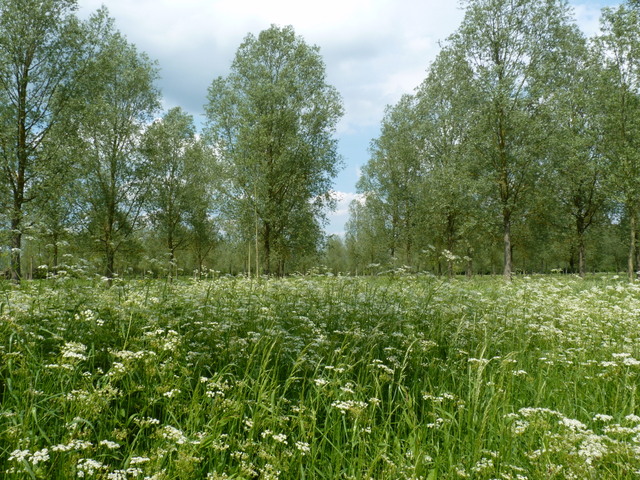
Trees and geography. The best bats made throughout the world seemingly are made of English Willow sourced from South East England primarily from my own county Essex and the adjacent county Suffolk. The wood is grown in a haphazard way in that there doesn't seem to be such a thing as enormous Willow woods set aside for just that purpose. If you search 'Willow wood plantation' you'll find images of small plantations, instead land-owners are encouraged to grow the tree as a long term investment seemingly in relatively small copses. The tree is often associated with damp areas and rivers, and throughout Essex you'll see rivers lined with Willow trees.


The English version
The best bats in the world irrespective of where they are made use the same wood, almost exclusively from the same source - JS Wright in south east England, just up the road from where I live. The tree that is grown is  found primarily in the Northern Hemisphere... "salix alba caerulea"or White Willow that has the characteristics and properties that suit high quality bat making...

The climate, geography and growing conditions in this part of the world combined with nearly 2 centuries of forestry and agricultural skills mean that the properties of this wood are unique. So unique that virtually every high quality bat has it's origins in this small area.
Bat Willow (salix alba caerulea).
And this is down to the climate and geographic features. I have noted whilst researching this article that there companies based in the north of the UK that have started to grow willow for the same purpose see here but having said, that this opening article alludes to the fact that they confirm that they get most of their willow from the region I've indicated.


Is Kashmir willow any good at all and why has it got such a bad reputation?


Positive - Kashmir http://www.ebay.co.uk/gds/Buying-Cricket-Bats-HELP-The-myth-and-scam-of-EWNI-/10000000010832242/g.html

http://shop.dreamcricket.com/dreamcricket/pavilion/buyingguide_Englishwillow_versus_kashmirwillow.asp

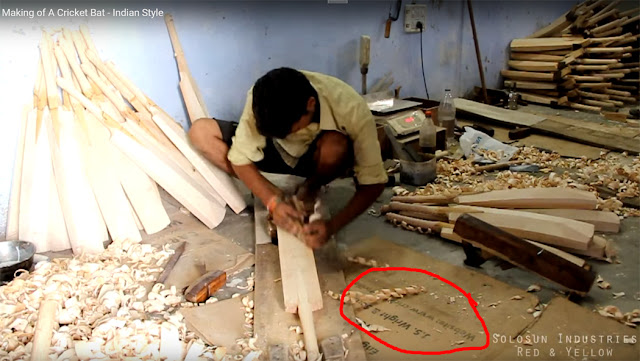
This image here is from a video on Youtube at 3 mins into the video the bat-maker is seen shaping a bat and if you're observant you'll notice that the piece of cardboard that he's squatting on is from the willow supplier JS Wright indicating that this bloke produces top quality bats using English willow in India. Which adds more confusion to any claims that bats made by small operations in India make false claims about the proprietary of their products.(Double click the image for the video).


It seems that without doubt if you can bat and you're an opening batsman or a middle order batsman that can hit the ball with ease and finesse, there's little reason to choose Kashmir if you can afford the real deal. There's an annoying Youtube bloke here that makes a good case for using one or the other and if you can get past the dumb self promotion inserts it's worth listening to.

So what are the differences - why is there such a massive difference in price and quality?

If you do pay nearly £300 for a bat it strikes me that you're going to be able to use it properly and you're going to look after it. Buying an expensive bat doesn't mean that the bat is going to last years and years, especially if you're not that good at batting. All of the top quality bat manufacturers advise that their bats should be knocked in, but they all have a legal caveat that says that if they break the first time they're used that's your fault not the bats or the manufacturers. There is a really interesting article on cricinfo that discusses the trends in bat making pointing out that the leaders in this industry respond to the styles and approaches used by international batsmen. Currently the trend is towards big thick edged bats but with no additional weight factor. As a consequence the bats that are made for pro's are very different to those bought from the shop.
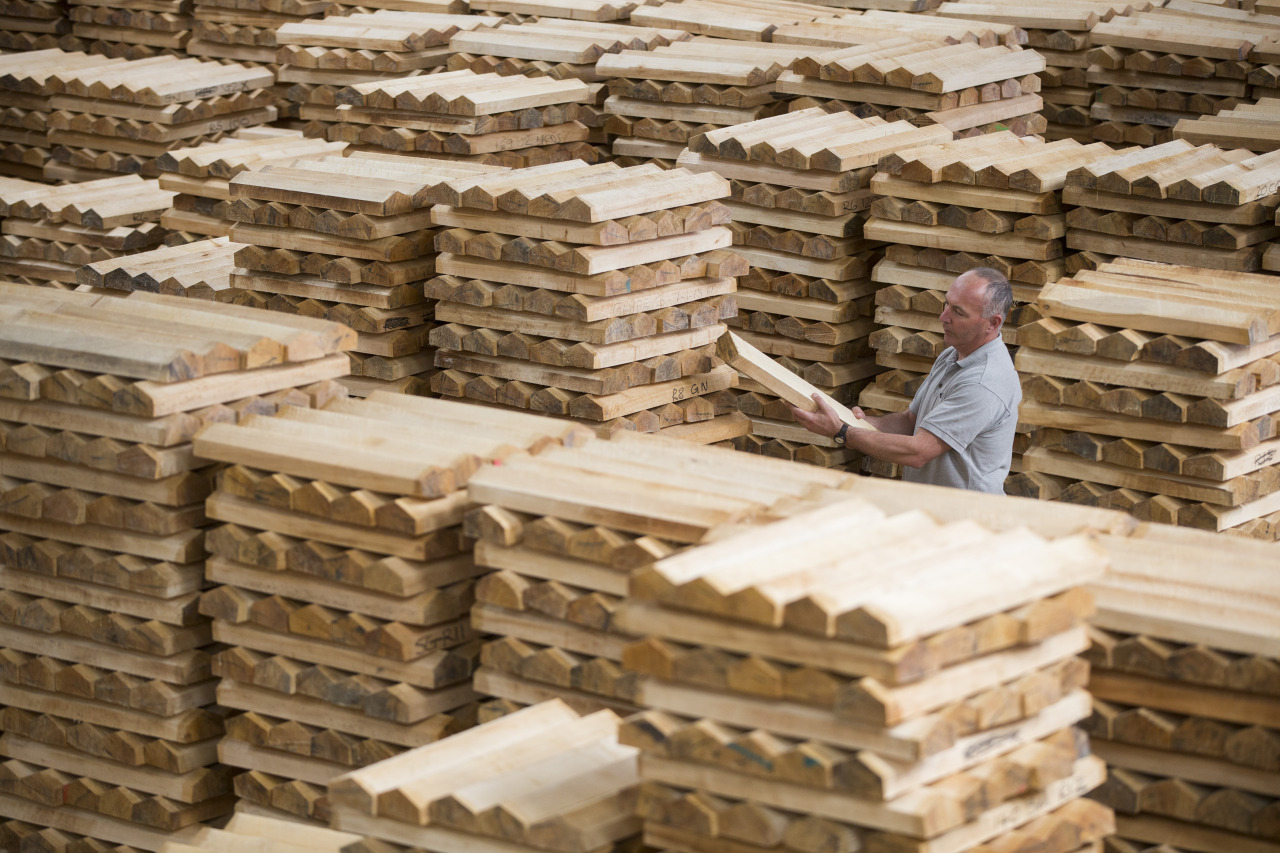
http://neilhallphoto.tumblr.com/post/123536249556/willow-to-the-crease-the-art-of-creating-cricket
Double click image for Neil Halls documentary images of cricket bat manufacturing.

The manufacturers who sponsor batsmen are constantly looking for individual clefts that fulfil this near impossible combination of weight, shape and strength and the expectations of the wood are now being pushed to the limits of attainment, with an acknowledgement that the bats wont last. In response the manufacturers then have to produce a similar bat for the club players and the next grade down is chosen, but the longevity, durability and strength of such a bat pushed to it's physical limits is such that they are susceptible to breaking. What you end up paying for is a superbly made bat, that works well and plays well up to a limit. But it's not the bat that you see the worlds best players using.

As one of the respondent's to the linked article above says...

"Truth of the matter is, general public simply does NOT have access to the grade of willow reserved for international batsmen. That willow is already filtered out at J.S. Wright farms and kept away from being shipped to general bat makers. Asian bats that are big, light and available to general public are basically over dried clefts of willow that is pressed very, very lightly or not pressed at all. This gives a bloated look to the bat but fact of the matter is, such willow is no comparison to naturally super low density clefts that are used by international pros".

Kashmir Willow on the other hand is a completely different prospect primarily because the wood is denser and heavier and therefore can't ever compete on the same level as the English Willow grown in South East England (JS Wright).

I'm currently in position where I feel that Kashmir willow definitely has its merits for any mortals who don't fancy themselves as over-looked Steve Smiths or Joe Roots. Let the deluded fork out hundreds of pounds/dollars for an inferior version of the bat that they see the pro's using in belief that there is some kind of comparison. Whereas possibly (and I am saying possibly because I might be totally wrong) the better option given their skills might be the much maligned Kashmir bat - denser and heavier and potentially better for hitting the ball for fours and sixes?  So why not consider Kashmir or at least give it a go?


Looking at it and wondering why it had lasted so long I wondered if the bat face tape had anything to do with its longevity? I'd also always been puzzled by the fact that being covered in bat-face tape - how did it last this long without being oiled? So some research was done (See below) into knocking bats in and I discovered a few things as we went about the process of getting the bat ready to use.

Joe's Slazenger V1200 Premier
  • Despite the fact that the bat has been pre-knocked in, virtually everyone says that it still needs to be done for a few more hours.
  • Oil the bat 3 times over 3 or 4 days. Oil it and then leave it for 24 hours. Only a small bit of oil is required
  • The edges of the bat are important and so too is the toe and these will need special attention see below.
  • A lot of people smooth off the edges of the bat rubbing another round piece of wood (The handle of a mallet or bat grip cone) run that along the edge and round it off. Then, initially very gently, start to knock the edges in gradually over the first hour.
  • The willow is very soft and you'll see it easily dent as you start to compress it with the knocking in process.
  • It is going take hours and it is going to get on everyone's nerves because it is noisy.
Problems that they don't tell you about...


8/9/15 Update on this bat.

It's the end of the season and it's going well, no obvious damage to it at all and Joe's score runs with it and I've borrowed it a couple of times and similar to Joe scored runs and if weren't for the bloke at the other end being bowled we both looked set to beat our current best scores in a match with this bat. It seems to be that it's light and has a good pick-up and we've just been able to play with a lot more aggression and positivity. I'm so impressed with the bat I've just ordered one for myself!

I then thought okay who is this company, and what's the deal with the English Willow? Knowing a little bit about this I thought this claim could easily be stretching the truth a little or it could be an outright lie.
Scenario 1. It may be that this is a genus of Willow that is found primarily in the Northern Hemisphere "salix alba caerulea"or White Willow that has the characteristics and properties that suit bat making, has been taken as saplings or seeds and then grown in India. So in essence you could claim that this is 'English Willow' because it's the genus that is found in England?
That sounds to the uninitiated like a fair ploy, but you miss some fundamental facts that are massively important when looking at Bat Willow (salix alba caerulea) above and its properties and characteristics... The growing conditions. I might be wrong, but I've always been under the impression that the worlds best superior willow is grown in a specific area in England - Essex or Suffolk (See map).

And this is down to the climate and geographic features. I have noted whilst researching this article that there companies based in the north of the UK that have started to grow willow for the same purpose see here but having said, that this opening article alludes to the fact that they confirm that they get most of their willow from the region I've indicated.
So any willow that is grown outside of East Anglia (Essex & Suffolk) and stored in conditions and weather found in the same region, doesn't have the same properties and characteristics. Yes it's the same tree genus, but the weather and growing conditions do not produce the same superior willow.
Scenario 2 Even more unlikely - they buy all the duff wood from companies such as JS Wright & Sons and GR Green, put it in containers and ship it out to India to make bats that they can claim are made of English willow? Again, I can't find any evidence of this at all and even if they did - it would be the duff wood that we reject.
Scenario 3 They just lie? The wood is bog standard Kashmir Willow grown in India.
You've only got to type in cricket bat manufacturing in Youtube and you'll get a massive insight into the type of industry this is and the scale of these industries. This video here gives a good over-view...
Furthermore if you try and look deeper into the company that has supplied my bat, you'll struggle to get that far, the details are very scant, but it appears to be a similar small scale company as those you'll find if you search Youtube as suggested above.

Bibliography/Sources

Salix Cricket Bat Company
http://www.salixcricketbats.com/inside-salix/manufacturing.html
Imperfections in Willow
http://www.cricketbatwillow.com/imperfections-in-willow
English Willow facts
http://www.quantumcricket.com/willow.html
JS Wright and sons
http://www.cricketbatwillow.com/
Buying and choosing Kashmir cricket bats
https://www.youtube.com/watch?v=PcnzdUNPKm8
Master Bat makers view on bats
http://www.espncricinfo.com/magazine/content/story/787773.html

Conclusion at this point so far.

I'm quite happy to take the risks involved in this process, it may be the case that both these Ebay bats play like dogs, but if you do your research there are a number of pro's and con's relating to the use of Kashmir Willow bats and this bloke here explains the differences in a neutral way.
The main reason I advocate their use is that neither my son or I bat that well and it's pointless buying an expensive bat. Yes, we could buy cheap Kashmir Slazenger bats where you know what you're buying and you can go to the shops and pick one up and feel the weight and whether it suits you, but a bigger thicker bat such as Bat 3 as far as I'm aware you wont be able to buy for £30. It's a risk, but that remains to be seen. Watch this space.


The conclusion - If you have a look at the other 3 posts where I bought and knocked in a couple of Kashmir bats, you'll see that I've had to come to the following conclusions below. My mission here was to actually test these out and offer some evidence as to why they are either good or bad. Unfortunately, they did turn out to be pretty poor...

(1). There's no apparent grading system for them, you can't seemingly buy Kashmir Willow of better quality. It may be the case that if you're in India there's some way that you can source the wood closer to the point where it's shaped and therefore make choices about the bat you buy, but here in the UK this isn't possible and you have to buy what's on the shelf.

(2). A high quality English willow bat here in the UK is going to cost you almost £500, a bat that costs £30 is never going to match that. But what might that £30 be capable of - it would never be good enough for a bloke that expects to walk out on the wicket and score 50 runs every game, but would it be any good for a tail-ender?

(3). Both the bats were knocked in to some extent despite some of the advice on-line advising not to do so. Both bats despite being knocked in to differing extents suffered major damage within a short period being used in the nets against Bola plastic cricket balls. Neither bat was used against being propelled at a speed faster than 68mph.


Finally my next move is to look at this company as an option...
http://www.msrcricketbats.co.uk/about-msr/


Bibliography/Sources...
https://www.youtube.com/watch?v=PZkIV6jz8h4

https://www.youtube.com/watch?v=PcnzdUNPKm8
https://www.youtube.com/watch?v=zrEUC42Vi5I
https://www.youtube.com/watch?v=BffU7Fwx3Qk
https://www.youtube.com/watch?v=Z_e3AFndzmM
https://www.youtube.com/watch?v=hgM8ouMuiJQ
https://www.youtube.com/watch?v=410v5fkvoYI
http://www.handmadebats.co.uk/store/index.php?route=information/information&information_id=9
https://www.youtube.com/watch?v=aEbEENWnICo - Jason Mellet
http://www.gettyimages.co.uk/detail/news-photo/an-employee-shaves-wood-from-the-blade-of-a-handmade-warsop-news-photo/473977596
http://cricketgearreviews.com/the-deep-and-dark-secrets-of-cricket-bat-making/ - Jason Mellet
http://www.planetcricket.org/forums/threads/english-and-kashmir-willow.42007/page-2
http://www.cricketdirect.co.uk/all-about-cricket-bats.aspx
https://www.youtube.com/watch?v=qmwLa5gALio
 - this video is interesting as it's a bat being made in India
http://www.bbc.co.uk/news/business-35070666  - Kashmir willow


For an objective test on Kashmir bats have a look at this video here (Click on the image).
https://www.youtube.com/watch?v=HU1qJFAdZ0Y


My other active blogs include…

This is an example of some of the bowling vids on my Youtube channel

Friday, December 25, 2015

Knocking in, preparing and road testing Kashmir Willow bats - Slazenger V1200 Pemier cricket bat

This blog has now been moved to my new website.

www.wristspinbowling.com

Click the link to check it out.


This is one of a number of blog posts where I'm looking at the Kashmir bats and whether they really are that bad? There's loads of opinion out there about how bad they are, but very little in the way of explanations and evidence. I'm testing out three this season, knocking them in over the winter and then I'll be using them in the nets and over the season in 2016. (See bottom of the blog for the other 2 bats).

Slazenger V1200 Premier cricket bat shop bought here in the UK

This bat is one of three that I've bought over the winter here in the UK to test out how good or bad Kashmir Willow is. This bat is the only one that I've bought from an established retailer, the other two bats (See links at the bottom of the page) are cheap Ebay bats sold as English Willow. This bat at least claims to be Kashmir Willow and I know what I'm buying. Why am I doing this? See here.

If you have a look at the link above you'll have seen we've previously had one of these bats that we partly knocked in and despite this we've been happy with its performance and wear. With that in mind I thought I'd buy another one specifically for myself and spend the winter preparing it as if it were a good quality bat.

There's a lot of conflicting advice and opinion on the internet on the subject of knocking in bats, primarily it's with reference to preparing top quality bats and not ropey cheap Kashmir bats. I questioned one blokes advice that was at odds with Julian Millichamps and I then got into a discussion about Kashmir bats and he was totally dismissive of them saying that they were a complete waste of time and that you shouldn't even knock them in. I kind of get the impression that there's an element of snobbery involved in some people's choices of bat and that many of the opinions regarding Kashmir willow are based on hearsay rather experience. With regards the comment and advice about not knocking in Kashmir willow bats, that seems to me on the basis of recent experience to be nonsense. The image here is a £25 Slazenger bat that was used sparingly over a season primarily against spin bowling during practices, that wasn't knocked in and it now looks like this...
Slazenger Bat - that wasn't knocked in.

Slazenger V1200 Premier cricket bat

The specifications for this bat are... 
Slazenger V1200 Premier Cricket Bat
This Slazenger V1200 Premier Cricket Bat is perfect for an aggressive stroke player due to the premium Kashmir willow construction, providing long lasting durability. 

Cricket Bat
Kashmir willow construction 
Toe guard
Octopus grip

Lightweight  - *Hmm - 2lb 11oz - not massively lightweight.
Slazenger branding

For our full range of
Sports Equipment Sale visit SportsDirect
Product code: 851032
Day One. (20th Sept).One of the things that comes up in one of the  videos I watched is the initial rounding of the edges of the bat. On their video they suggest not doing it (Certainly at the initial stages) with a bat mallet. Instead they suggest that you use a piece of rounded wood (I’ve used my wife’s rolling pin) to rub down the sharp edges rather than smashing them in with a bat mallet. So, unsure whether you do this post oiling or pre-oiling, I’ve done one edge so far prior to oiling and the wood felt pretty hard. So without any oil this rounding process was pretty difficult, but with a little exertion though, there was some softening of the edge.


After doing the one edge I’ve then coated the front face of the bat with Bat oil (Raw Linseed Oil). Don’t use any other type. I’ve drizzled about 1 tea-spoon (5ml) on the face of the bat and smeared it into the wood with my fingers. I’ve also done the edges of the bats trying to avoid getting it on to the stickers. Anything that went on the stickers or looked excessive and not readily absorbed into the wood I wiped off with a tissue.
 
Day Two. (21st Sept).
Coat 2 of 4; The oil applied 24 hours ago has now been fully absorbed into the bat and the surface is dry once again. So this evening I've applied the 2nd coat. Exactly the same process. No knocking in, no rolling of the edges with the rolling pin. Apparently once the 4 coats have been applied the Willow will fairly soft in comparison with the dry state that the bat is delivered in.

One thing I've been made aware of is the fact that my bat has two types of wood found in the tree when it's cut down. Looking at the wood it has two colours. The darker colour wood is the 'Heartwood' and therefore a lot harder than the lighter colour wood and requires more Oiling, so when I'm oiling up the bat from now on I'm going back to the bat a couple of hours later and applying an additional drop on both this darker Heartwood and on the toe. Remember the advice from Warsop (see above) that says that no matter how much you pay for a bat or much you knock it in, a Yorker right on the toe of the bat will potentially kill your bat. To help alleviate this you need to pay particular attention to the toe and Jason Mellet recommends additional oil needs to be applied to the toe in the same way as the heartwood .
Day Three (22nd Sept). Tonight I'm just going to add a drop to the toe and the heartwood and allow the rest of the bat to fully absorb the oil already applied.
Day Four (23rd Sept). No more oiling tonight, the surface of the bat feels waxy, certainly not wet or damp, but I don't want to over oil it, so I'm going to leave it for a few days and see how it looks and feels possibly at the weekend. I've been looking for advice on removing the Toe Guard, but there's not a lot out there, but it is as basic as stick a knife under the edge and slowly ease it off. Again I'll look to do that at the weekend.
26th Sept.
Saturday morning I've worked on the bat with a rolling pin. The advice on one of the sites was to smooth the edges initially by using another rounded piece of wood, so I've used a cooking rolling pin and as you can see it's done the initial part quite well...

This was done by simply rubbing the rolling pin down the edge and you can clearly see that it takes that sharp edge off quite easily and in doing so demonstrates how soft the willow is and how important it is to work on that edge.

Once I'd smoothed off the edges using the rolling pin, I then started to work on them with the bat mallet, small taps all around the edges and on the toe. I've worked on both edges at this stage only lightly and on the toe, more work has been put into the toe than the edges at this stage and I must have only done about 10 minutes of knocking in.

25th October.  I've decided that I'm doing this slowly, so what with it being off-season here I'm only doing this every now over the week, but it's going well. I've been leaving the bat in the garage and I did leave it for a few weeks and then oiled it again with a very light layer. I'm increasing the hardness of the impact with the knocking in hammer and I've probably spent a genuine 40 minutes now of knocking it in over this period of time and so far there are no cracks or damage to any part of the bat. I've still got the toe guard in place - I couldn't figure a way of taking it off without making a complete mess of it. So I'm hitting the toe with the toe guard in place, whether this means I'm compressing the willow enough I'm not sure, but I am increasing hitting the toe harder and it may be because the toe guard is rubber it's just moving (Compressing) with the willow?
 
28th November. Every week generally at the weekends now, I spend a little bit of time continuing to knock this bat in and this weekend I've put a little more Oil on the bat as it had fully absorbed the oil. The striking of the bat is quite violent now and there's a lot of focus on the edges and the toe. Whereas in previous weeks you could see the bat compressing as it was being hit, it now appears to be pretty much done, with virtually no indication of being struck at all. Being someone who doesn't do a job that involves manual labour, I can't smack the bat continually for any period of time, I just haven't got the strength in my forearms, so at most I do this for 3 - 5 minutes at a time. I'm also very conscious of the fact that no-one likes the noise and the fact that it must get on everyone's nerves (Neighbours). I do it in the garage where the bats are stored, but my wife says that she can hear me doing it from inside the house, so if she can hear so too can 30-40 other people.
I'm getting to the point where I doubt whether many people actually complete the recommended 6 hours especially if they've bought the bat for such a small fee, it's almost certain that people must buy these types of bats - use them for a season or in the nets and then either break them or discard them?

7th December

Had a net session a couple of days back and gave the bat a run out and it did okay remembering I can't bat. Seems to have a nice ping in the middle and the balls at 60mph + made no indents at all. Since then I've continued to knock it in and will do so over the coming months, as I've said before, I'm now making no impression on the bat at all and I do wonder if anyone knocks these bats in for any more than half an hour. I'll continue, but I am doing it at about 20-30 minutes per weekend.
25th December 2015
This bat must now be nearing having had its full 6 hours of knocking in, but I'll continue to knock it in over the rest of the winter. I have read recently that there's no limit to how much you might knock the bat in, but six hours to me seems to be a fair enough effort. I'll now order the face and edge tape and it'll continue to be stored outside laid flat in our garage and I'll start to put it to use at the end of January in the pre-season nets. The only other thing I'll do is weigh it and see how it compares to the other two bats that are also being prepared for the same experiments - see below...

28th December 2015

Bad news for Kashmir... Despite all the knocking in and care and attention I've used the bat tonight in the nets against plastic 'Bola' balls - 5oz relatively soft plastic. Unfortunately the bat hasn't been able to handle them despite only being subjected to 150 balls approximately. The willow looks as though and feels as though it is starting to delaminate - above.
 The toe has developed some small cracks as well, so overall this is pretty damning for Kashmir. As far as I'm concerned I've probably knocked this bat in pretty well and it's been stored in good conditions (garage outside - cool and airy). I'm not going to give up quite yet... What I plan to do is glue up the cracks using super-glue and then use bat face tape and edge tape on this bat and then continue to use it in the nets over the coming months and see how it goes once covered in bat face tape. But... It doesn't bode well for Kashmir.

2nd Jan 2016

Just had another look at the now delaminating Slazenger V1200 and pondered what I should do with it, I've considered no longer knocking it in - which as I've said is pretty much done and just simply putting bat face tape over it. I've had a look around on the internet and found this forum discussion here http://custombats.co.uk/cbforum/index.php?topic=30549.0 having read through it, the advice I'm going to take and go forwards with is...

"So I spoke to B3, David to be precise. Decent chap. He advised me to use it until there is a significant enough split in the playing surface so they can get access to the gap and then glue it.
Make it worse. Cruel to be kind.

Seems like I'll have to use a scuff sheet after all when it's repaired".

 
So, I'll continue using it in the nets until it reaches the point where I can get some glue into it. Hopefully that's going to be next Saturday. Watch this space to see what happens next. In the meantime I'm now eyeing up... http://www.barringtonsports.com/products/new_balance_2016_dc_580plus_cricket_bat_2015/26971/view
10th Jan 2016

Used the bat again in the nets against Bola plastic balls with the machine at 65-68mph and it's come through okay. The other Kashmir bat though didn't do so well once we introduced it to some real cricket balls see here Ebay Bat no. 2:11

17th Jan 2016 - 4 months to the start of the season.

I've ordered some Extratec bat facing tape to put on this bat as well, both the Kashmir bats as everyone everywhere says are pretty poor. But, I'll tape it up, put some edge tape on this one as well and see how it goes. I've now pretty much accepted that you get what you pay for with Kashmir and that knocked in or otherwise if you can actually hit a ball they're probably not going to last more than a few games. But if you're a bowler like me, they may last you a season if you rarely hit the ball. I've been working on my batting so I'm hoping to be hitting the ball with a bit more frequency, so I'll give this bat a go and see how it fairs, but to be honest if I use it in winter nets which I may do I doubt if it'll even survive till May when the season starts.

31st Jan 2016 -

The Extratec tape came and it was applied to the bat with edge tape. Not sure now what I'll do with the bat, I may use it in the nets against cricket balls in February and see if it survives. In the short term Joe's going to buy his own English willow bat a Grade 3 New Balance bat and see how that goes? So for the moment no news on the progress of this bat till I start using it in February nets.

The other two bats are here...

Ebay Bat no. 2:11

Ebay Bat no.2

Update on this bat here and it's doing okay March 2016 http://mpafirsteleven.blogspot.co.uk/2016/03/kashmir-bat-update.html

Thursday, July 23, 2015

Knocking in and preparing Kashmir Willow bats


Knocking in and preparing Kashmir Willow bats
(And Ebay cricket bats).


Introduction...

If you bat down the order 8,9,10 or 11 like we do - as we're bowlers is it necessary to pay a lot of money for a cricket bat? At our club and others you'll see blokes with very good cricket bats that cannot get the bat on the ball and I find myself asking the question - did you really need to pay top dollar for a piece of quality willow that you cannot use? What is the issue with buying a cheap bat if you're only hitting the ball 3 or 4 times in a game and the 3rd or 4th time it invariably ends up in the hands of the opposition?

So what is the deal with Kashmir bats why are they dismissed so readily, are they really that rubbish?

My own experience of Kashmir bats hasn't been that bad, one bat that wasn't knocked in at all lasted me a few years, although as a bowler I didn't get to use it that much other than in practice, but another bat a Slazenger V1200 which I picked up 2nd hand along with a Fearnley Gold (which I'm still using) lasted years with good service before finally succumbing to a Yorker off of a cheap ball in the nets, the bat was somewhere near 10 years old by my reckoning.

This bat led me to buying another Slazenger V1200 premier off of the much maligned Sports Direct. Again a Kashmir willow bat and dirt cheap at £14.00. Looking at the previous model and wondering why it had lasted so long, I could only deduce that it may have been knocked in properly and that it was covered in face and edge tape, so I looked into what I needed to do in order to knock it in and prepare it. I did some research (See the links at the bottom of the page) and tried to make sense of all the information. There's quite a lot of advice out there which differs, but it almost exclusively deals with top quality willow bats. So, what I've done here is taken the bits that seemed to make sense to me or came up as consistent messages and turned them into something that was useful to me as an advocate of Kashmir willow bats. In addition to the treatment and preparation of Kashmir willow bats I've also looked at how much they differ when buying from shops or off of Ebay from suppliers in India.

So if you fall into any or some of the categories below, this post might be useful to you.
  • Someone who can't bat/beginner.
  • Tail -ender/bowler.
  • Playing cricket for a laugh.
  • A parent of a kid that's just starting out.
  • Someone who can't justify paying top dollar for a bat.
  • Not bothered by the snobbery around labels and names.
What we did - how we went about it.

This is the bat...


At £14 it seemed a good gamble to give it a go. It comes with some indication that it's pre-knocked in. Looking at the articles on cricket bat manufacturing, this probably means the bat has been compressed rather than struck in the way that 'Knocking in' prepares a bat. I can't imagine that Slazenger do this to thousands of bats, whereas the pressing process seems more likely.

Knocking in is a far more vigorous and affective way as far as I can make out, especially if you do it yourself.

The first time we did this we did it without any prior knowledge and we didn't spend a great deal of time on the process - probably 2 hours. The subsequent time we prepared the same type of bat, we did so with more knowledge and you'll find that account here. The rest of this article discusses the problems we faced and how we overcome them the first time we knocked in a bat.

One of the biggest issues that we came across was the fact that the bat had a toe guard on it - a rubber protector right on the end of the bat which prevents you from knocking in the toe of the bat correctly...

The Toe Guard - Most cheap bats like ours come with a toe guard. When you start to work on the toe of the bat and remember this is the most vulnerable part of the bat, the rubber toe guard prevents you from knocking it in properly. I made the mistake of knocking in the bat every where except for the toe and then once we'd knocked 97% of the bat in, the first aggressive session in the nets saw the toe of the bat cave in on the corner after mis-hitting the ball right on the toe. Interestingly in my research I found an interesting article about Warsop bats where they basically say that every bat is susceptible to being ruined by a Yorker right on the toe, despite having paid £350 for it and having knocked it in properly!

Once Joe's bat was damaged in this way, I had a look at it and then reflected on how much the edges of the bat had changed in shape through the knocking in process. Thinking about it, I thought - if I was to remove the rubber toe guard and knock the toe in properly would the knocking in process even out the now deformed and caved in toe? 

I removed the toe and knocked in the toe properly - lightly at first and gradually increasing the weight of the blows and luckily once knocked in the shape of the toe evened out and the caved in section was eliminated - luckily the blow from the ball had only compressed the willow and not actually cracked it.

You can see from the image above that once the toe guard had been re-fitted it was now too big for the shape of the knocked in toe. The knocking in process has compressed the willow substantially, so once the toe guard had been glued back into place using super-glue, then used a Stanley knife to cut the excess off making it neat once more.

Cracks in the willow as part of the knocking in process.

Again this hardly gets mentioned and I found the answers on a forum and the Warsop website, the Warsop website sells them as a positive feature of your bat!!! The forum discussed the idea of the bat being defective and whether you could return the bat I'm guessing from the point of whether it meets the fit for purpose consumer laws? On the forum they were undecided, but most of the discussion centred around the idea that the cracks as Warsop suggests are no big deal and that they can be repaired by applying a little bit of super glue and then rubbing down with fine sandpaper. Follow that up with some bat face tape and the edge tape and your bat hopefully will be ready to go!

Linseed Oil use with a bat covered in bat-face tape.

Easy! Before you put the tape on with your new bat (3 coats or more over several days) make sure the oil has dried out. Our whole process took more than 8 days. If the oil is sitting on the surface of the bat wipe the excess away with tissue paper or a cloth. Make sure though that the oil has been absorbed into the bat before applying the tape otherwise it wont adhere to the surface of the bat. Once the tape is on and when it comes to the point where you need to re-oil it, all you do is oil the back of the bat instead of the batting surface. Don't go over the stickers, oil round them and similar with the splice area where the handle connects to the bat. Lay the bat oil side up and flat when waiting for the oil to seep into the Willow.

Storage.

Keep the bat over winter in a garage, shed or out-building somewhere where there is some moisture in the air - not indoors where there is central heating. Similarly don't leave the bat in a car on the parcel shelf where the sun will dry it out.

How is the bat holding up? The bat saw my son through a season and I've used it a couple of times and it's doing okay see image below. If you look at the Slazenger link below you'll find an image of a similar more expensive Kashmir bat that wasn't prepared. The bat featured in this post looks in good condition and is going fine.

A more detailed account of the same process done with far more care on a 2nd bat can be found via the links below along with the same process being applied to Ebay bats from India. All three bats will be tested this season 2016 and I'll update these posts below as to how they performed.

Slazenger V1200 Kashmir bat prep, knocking in and test - http://mpafirsteleven.blogspot.co.uk/2015/12/knocking-in-preparing-and-road-testing.html

Ebay plain bat from India bat prep, knocking in and test -
http://mpafirsteleven.blogspot.co.uk/2015/12/knocking-in-and-preparing-kashmir.html

Ebay plain bat from India bat prep, knocking in and test -
http://www.mpafirsteleven.blogspot.co.uk/2015/12/ebay-kashmir-willow-bat-purchasing.html


Check out my other blog here - this is all about Leg-spin bowling and nothing else. Double click on the image.

http://www.legspinbowling.blogspot.co.uk/


.